In 2018, I flew to Dongguan to visit a "factory" that had been supplying me plastic components for three years. The samples were consistently excellent. The pricing was competitive. The communication was professional — fast responses, decent English. But when my taxi pulled up to the address on their business license, I found myself standing in front of a three-story office building with a coffee shop on the ground floor. No loading dock. No smokestacks. No factory. The supplier had been subcontracting my orders to three different small workshops and marking up the price 40% for three years.
That trip cost me $1,800 in flights and hotels. It saved me $120,000 in future overpayments.
I've since visited over 200 factories across 15 Chinese cities. I've developed a systematic approach to factory visits that separates genuine manufacturers from middlemen, identifies quality risks before they become defective shipments, and — critically — builds the kind of in-person relationships that lead to better pricing, priority production slots, and first access to new products. This is that system.
Why You Need to Visit Chinese Factories in Person
Let me be direct: if you're sourcing products from China at any meaningful scale — say, $50,000+ in annual purchases — and you've never visited your suppliers' factories, you're almost certainly overpaying and taking on unnecessary risk. Here's what in-person visits reveal that video calls and photos can't:
When a Factory Visit Is Non-Negotiable
You should physically visit when: (1) Annual order volume exceeds $50,000, (2) You're developing a custom or private-mold product, (3) The supplier is new and unverified, (4) You're considering a long-term exclusivity agreement, (5) Product quality is safety-critical (toys, electronics, food contact), or (6) Your gut says something is off despite good samples and communication.
Phase 1: Pre-Trip Preparation (4–6 Weeks Before Departure)
The difference between a productive factory visit trip and an expensive sightseeing tour is preparation. Here's the exact pre-trip workflow I use:
Step 1: Supplier Shortlisting & Qualification
Don't fly to China hoping to "discover" suppliers. Your trip should validate suppliers you've already vetted remotely. Here's the funnel:
- Start with 15–20 candidate suppliers — sourced from Alibaba, 1688, Global Sources, trade show contacts, and referrals.
- Remote qualification: Request business license, factory photos (dated, with specific angles you request), 3 recent customer references, and production videos of your product category.
- Sample order: Place a small paid sample order (not free samples — paid samples reveal their actual fulfillment capability). Evaluate quality, packaging, and communication throughout the process.
- Narrow to 5–8 visit-worthy suppliers — these are the ones you'll schedule on-site visits with.
- Group by geography: Organize visits by manufacturing cluster (see Phase 2 below) to minimize travel time.
Step 2: Visa, Logistics & Documentation
⚠️ Visa Reality Check — Plan Ahead
China's visa process has become significantly stricter since 2024. For a business visa (M visa): you need an invitation letter from each factory you plan to visit, on their official company letterhead with their business license number and company chop (stamp). Processing time: 2–4 weeks in most countries. Do not book flights until your visa is approved. Some nationalities (US, UK, EU, AU, CA) can use the 144-hour transit visa exemption in certain cities (Beijing, Shanghai, Guangzhou, Shenzhen), but this restricts you to one region and requires an onward ticket to a third country.
Essential documents to bring:
- Printed invitation letters from each factory (customs may ask)
- Business cards — essential in Chinese business culture; bring at least 50
- Product specifications, packaging requirements, and quality standards (printed and digital)
- The factory audit checklist (downloadable template — see below)
- Your own quality samples or competitor products for comparison
- A small notebook — you'll take more notes than you expect
- VPN installed and tested on your phone (WhatsApp, Gmail, Google are blocked without one)
Step 3: Schedule Factory Visits Strategically
Contact each supplier 2–3 weeks before your trip with a specific visit request. Here's the exact WeChat message template I use:
"你好 [Name],我计划在 [Month] [Date Range] 到中国访问几家供应商。我想在 [Date] 上午/下午参观你们的工厂。如果可以安排,请确认。我们主要想了解:1) 生产线和设备 2) 质检流程 3) 讨论新产品的合作可能性。谢谢!"
Translation: "Hello [Name], I'm planning to visit several suppliers in China during [Date Range]. I'd like to visit your factory on [Date] [morning/afternoon]. Please confirm if this can be arranged. We mainly want to understand: 1) Production lines and equipment, 2) Quality control processes, 3) Discuss cooperation possibilities for new products. Thank you!"
Key scheduling rules:
- Schedule no more than 2 factory visits per day — one morning, one afternoon. Each visit should be 2–4 hours.
- Leave buffer days for follow-up visits and unexpected opportunities.
- Don't schedule visits on weekends — most factories operate Monday–Saturday, but Saturday visits often mean skeleton crews.
- Avoid Chinese national holidays (Chinese New Year: late Jan/Feb; Labor Day: May 1–5; National Day: Oct 1–7). Factories close for 1–4 weeks during CNY.
- Tell suppliers you're visiting multiple factories. This creates competitive pressure and prevents them from assuming they've already won your business.
Step 4: The Factory Visit Kit — What to Pack
Phase 2: Manufacturing Cluster Route Planning
China's manufacturing isn't randomly distributed — it's hyper-concentrated in industrial clusters. Each city or region specializes in specific product categories, which means you can visit 4–6 relevant factories within a 2-hour radius. Here are the most efficient routes for common product categories:
| Route Name | Cities | Product Categories | Recommended Duration | Est. Cost (Excl. Flights) |
|---|---|---|---|---|
| Pearl River Delta (PRD) Electronics Loop | Shenzhen → Dongguan → Huizhou | Consumer electronics, IoT devices, phone accessories, PCBs, smart home, wearables | 5–7 days | $800–1,400 |
| PRD Manufacturing Corridor | Guangzhou → Foshan → Zhongshan | Home appliances, furniture, lighting, ceramics, hardware, bathroom fixtures | 4–6 days | $700–1,200 |
| PRD Toy & Gift Triangle | Shenzhen → Dongguan → Shantou | Toys, plastic goods, gifts, stationery, holiday decorations | 5–7 days | $850–1,500 |
| Yangtze River Delta (YRD) Textile Route | Shanghai → Hangzhou → Shaoxing → Ningbo | Textiles, garments, fabrics, home textiles, fashion accessories | 6–8 days | $1,000–1,800 |
| Yiwu Small Commodity Hub | Yiwu → Hangzhou → Ningbo | General merchandise, small commodities, hardware, stationery, toys, jewelry | 4–5 days | $600–1,000 |
| Fujian Consumer Goods Loop | Xiamen → Quanzhou → Putian | Shoes, apparel, bags, ceramics, stone products, tea | 4–6 days | $700–1,200 |
Pro Tip: Combine a Trade Show with Factory Visits
The highest-ROI trips I've done combine 2–3 days at a trade show (Canton Fair in Guangzhou, Yiwu Fair, or Hong Kong Gifts & Premium Fair) with 4–6 days of factory visits. The trade show lets you discover new suppliers and touch samples from 50+ factories in a single day; the factory visits let you verify the best ones. Bookend the trade show with factory visits — go early to visit factories before the show starts (when suppliers are less busy), attend the show, then visit your top picks after.
Phase 3: The Factory Visit — What to Look For
This is the core of the guide. I've organized the visit into a structured protocol that takes 2–4 hours and covers everything you need to evaluate.
The Visit Timeline (2–4 Hours)
| Time | Activity | Duration | What You're Evaluating |
|---|---|---|---|
| 0:00–0:15 | Arrival & Greeting | 15 min | Professionalism, punctuality, facility exterior |
| 0:15–0:45 | Meeting Room Presentation | 30 min | Company history, major clients, certifications, honesty |
| 0:45–1:45 | Production Floor Walkthrough | 60 min | Equipment, workforce, processes, QC, workplace culture |
| 1:45–2:15 | Raw Material & Finished Goods Warehouse | 30 min | Inventory management, material quality, order volume |
| 2:15–2:45 | QC Lab & R&D Area | 30 min | Testing capability, innovation, engineering depth |
| 2:45–3:15 | Sample Room & Product Review | 30 min | Product range, quality consistency, attention to detail |
| 3:15–4:00 | Closing Meeting & Business Discussion | 45 min | Pricing, MOQ, lead times, communication, cultural fit |
The 12-Question Factory Audit Protocol
During the visit, ask these questions — the answers (and how they're given) reveal more than any certificate:
A real factory has a production whiteboard or digital tracking board showing what's running on each line, due dates, and quantities. A trading company will say it's "in the office computer" or look uncomfortable. Red flag: They can't produce a production schedule within 2 minutes.
Below 60% = they need your business (negotiation leverage for you). Above 85% = they might struggle to meet your deadlines. Above 95% = risk of subcontracting your order. A factory manager who can't answer this immediately doesn't manage their production.
If 1 customer is >50% of revenue, that's concentration risk. If they won't name any customers at all, that's suspicious — legitimate factories are proud of their client list. If they name a major brand, ask to see product samples or packaging with that brand's logo (in the sample room or warehouse).
A good answer includes a specific percentage (e.g., "0.8% for injection-molded parts"), the measurement methodology (AQL sampling, 100% inspection for critical defects), and what happens to defective units. A bad answer: "We don't have defects" — every factory has defects; the honest ones track them.
This question separates manufacturers from trading companies faster than any other. A factory with injection molding, die-casting, or stamping must have a mold maintenance workshop. If they claim to do molding but can't show you a mold room, they're outsourcing production.
Walk the QC lab. Look for: tensile testing machines, environmental chambers, XRF analyzers (for RoHS/lead testing), drop testers, and calibration stickers with recent dates. A factory that sends everything to an external lab for testing is slower and less quality-invested than one with in-house capability.
This reveals whether QC is systematic or performative. A good factory has dated inspection sheets, inspector signatures, and non-conformance reports. The documents should show real defects being caught — if everything is "passed" without any issues flagged, the system is pro forma.
Look for a structured process: complaint received → root cause analysis (8D or 5-Why) → corrective action → preventive action → customer communication. A factory that says "we always rework or refund" without describing their analysis process is reactive, not systematically quality-driven.
High turnover (>30% annually) means inconsistent product quality — every new worker introduces variability. Low turnover suggests stable management and decent working conditions. Also note the average age of workers: a factory with only young workers (under 25) and no older ones suggests high burnout.
A trading company has no R&D. A genuine manufacturer has at least some engineering staff — CAD workstations, prototype samples, testing jigs. Even if they're not developing new products, they should have process engineers who design production fixtures and optimize workflows.
This is a trick question that reveals honesty. If they point to a specific machine and give you the model year, they're transparent. If they say "all our machines are new" — walk the floor and look at nameplates. Equipment more than 15 years old isn't automatically disqualifying (some old machines are workhorses), but it should be well-maintained and calibrated.
This tests production flexibility and honesty. A good answer: a specific lead time with conditions ("7 days if we have the raw materials in stock; 14 days if we need to order materials"). A bad answer: an unrealistically short time ("3 days guaranteed") — they're telling you what you want to hear, not what's possible.
The Visual Inspection: 5 Red Flags You Can Spot in 5 Minutes
🚩 Red Flag #1: The Factory Floor Is Too Clean
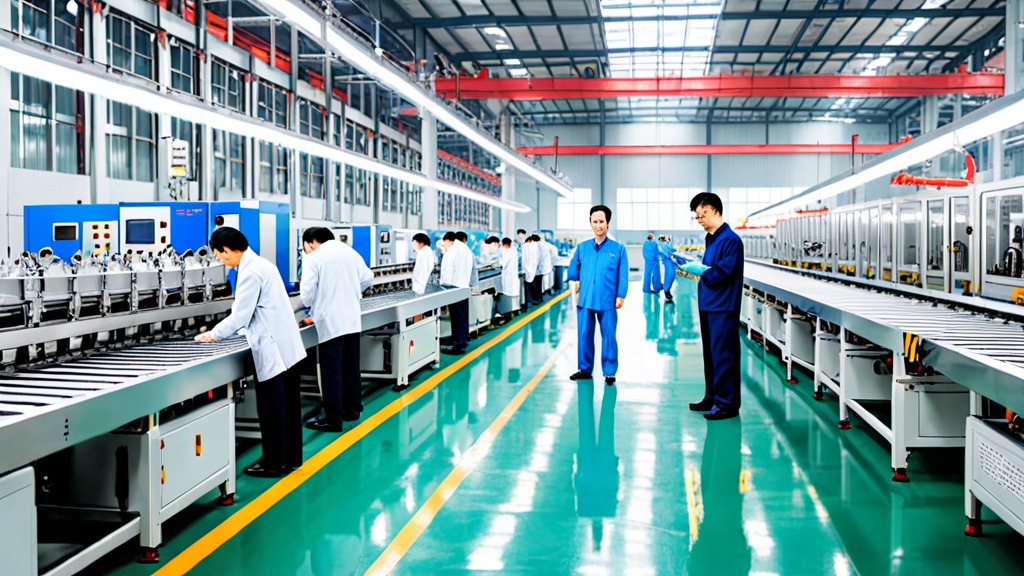
A working factory looks worked-in. There should be raw material at loading docks, finished goods in the warehouse, components staged at workstations, and a controlled level of noise and activity. A factory that looks like a showroom — pristine floors, no work-in-progress visible, workers standing around — was likely cleaned up for your visit. Or worse: it's not a real production facility.
🚩 Red Flag #2: No Company Name on the Building
Genuine manufacturers have their company name (in Chinese) displayed prominently — usually on the building facade or at the factory gate. If there's no signage, or the sign is temporary (a banner rather than permanent lettering), ask why. Some legitimate factories in shared industrial parks may have smaller signage, but zero exterior branding is suspicious.
🚩 Red Flag #3: The "Factory Tour" Never Leaves the Meeting Room
Some suppliers will keep you in the meeting room with tea, snacks, and PowerPoint presentations for over an hour — hoping you'll run out of time before seeing the actual production floor. Insist on a floor tour within the first 30 minutes. If they resist or make excuses ("the production manager is at lunch," "it's too noisy," "we're between production runs"), that's a major red flag.
🚩 Red Flag #4: Equipment Nameplates Have Been Removed
Nameplates on injection molding machines, CNC tools, and other equipment reveal the manufacturer, model, and manufacturing date. If nameplates are missing or painted over, the factory is hiding something — likely that the machines are older or lower-quality than claimed.
🚩 Red Flag #5: Workers Are Surprised to See You
If you're visiting a scheduled appointment and workers look shocked when you walk onto the production floor, that means management didn't inform them — which suggests the visit wasn't planned because there's something to hide. In a transparent factory, workers know visitors are coming and may even have been told to expect a foreign buyer.
The Production Floor Walkthrough: A Systematic Approach
When you're on the floor, move systematically through these zones — don't just follow the sales manager wherever they lead:
- Raw Material Receiving Area: Check material labels — are they from known suppliers? Are materials properly stored (temperature/humidity control for sensitive materials)? Is there a FIFO (first-in-first-out) system? Look for material certification documents.
- Production Lines: Count the actual number of lines operating (not just "installed capacity"). Observe: worker density per line, presence of work instructions at each station, whether line supervisors are actively monitoring quality, and whether in-process QC stations are actually staffed.
- QC Checkpoints: Look for: measurement tools at each checkpoint, defect tracking sheets, acceptable quality limit (AQL) reference charts, and whether inspectors are actually using their tools (not just checking boxes on a form).
- Finished Goods Warehouse: Walk through it. Look at: how products are packaged and stored, whether there are products labeled for recognizable brands (validates their client claims), the overall organization and cleanliness, and inventory management systems (barcodes, SKU labels, FIFO rotation).
- Maintenance Workshop: Check tool organization, spare parts inventory, and whether maintenance logs are up to date. A well-maintained maintenance shop directly correlates with consistent product quality.
- Worker Facilities: A quick look at the canteen and rest areas tells you about worker treatment. Well-treated workers produce better quality. Look for: air conditioning in workspaces (factories in southern China without AC have miserable summer working conditions), clean restrooms, and posted safety procedures.
Phase 4: The Cultural Dimension — Business Etiquette That Matters
The cultural aspect of factory visits isn't optional flavor — it directly impacts your pricing, lead times, and the supplier's willingness to go the extra mile for you. Here's what I've learned from 200+ visits:
The Business Dinner: Where Deals Are Actually Made
If a factory invites you to dinner, accept. This is not optional socializing — it's where the real relationship-building happens. Some rules:
- They pay. The host always pays. Offer to pay once (they'll refuse), then graciously accept. Fighting over the bill is normal and expected — but let them win.
- Toasting (干杯 gānbēi): When someone toasts you, clink glasses with your glass slightly lower than theirs (shows respect). If they say "干杯" (dry the glass), you don't actually have to chug — sip, and they'll understand. But for the first toast with the boss, finishing your glass earns major respect.
- Seating matters: The most senior person sits facing the door. Don't sit in that seat unless invited. Wait to be directed to your seat.
- Business talk: Don't dive into pricing negotiations during dinner. The meal is for relationship-building. Light topics: family, travel, food, your home country, Chinese culture. Avoid: politics (especially Taiwan, Tibet, Hong Kong), religion, salaries.
- Lazy Susan etiquette: Don't spin the lazy Susan while someone is taking food. Wait your turn.
- Chopsticks: Never stick them upright in your rice bowl (it resembles incense at a funeral). Rest them on the chopstick rest or across your bowl.
Gift-Giving Protocol
Bring a gift for the factory owner or general manager. It doesn't need to be expensive — $20–50 is appropriate. Good options: local specialty food from your country, a nice bottle of liquor (if they drink), branded merchandise from your company, or a coffee table book about your home city. Avoid: anything too expensive (creates an obligation), clocks, sharp objects, white flowers (funeral associations), or umbrellas (the word 伞 sǎn sounds like 散 sàn — to separate).
When presenting: use both hands. Say something like: "A small gift from my country — thank you for hosting me." They may refuse once or twice out of politeness; gently insist, and they'll accept.
Communication Nuances
- "Yes" doesn't always mean yes. Chinese business culture avoids direct confrontation. A supplier may say "yes, we can do that" when they mean "we'll try" or even "we can't do that but don't want to disappoint you." Follow up with: "Can you show me an example of when you've done this before?" or "Let's write that into the specification sheet."
- "No problem" (没问题 méi wèntí) is dangerous. When a Chinese supplier says "no problem" to a complex request, it often means they haven't fully processed what you're asking. Probe deeper: "Great — walk me through how you'd do that. What's the timeline? What could go wrong?"
- Silence is not awkward. In Western business culture, silence is uncomfortable and people rush to fill it. In Chinese business culture, silence means thinking. If you ask a question and get silence, wait. Don't rephrase the question or lower your ask — you'll undermine your position.
- Use WeChat for everything. After the visit, all communication should shift to WeChat. Email is for formal documents only. WeChat voice messages and quick text exchanges build rapport faster than formal emails.
Phase 5: Post-Visit Scoring & Decision Matrix
After each visit — ideally the same evening while details are fresh — score the factory across these 8 dimensions on a scale of 1–5:
| Dimension | Weight | What to Evaluate |
|---|---|---|
| Production Capability | 20% | Number of lines, equipment quality/age, capacity utilization, ability to scale, mold/engineering workshop, production technology level |
| Quality Systems | 20% | In-house testing lab, QC checkpoint staffing, defect tracking, certification validity, incoming material inspection, worker training programs |
| Management Professionalism | 15% | Transparency, production scheduling, responsiveness to questions, process documentation, worker-management relationship |
| Export Experience | 15% | English-speaking staff, familiarity with your market's regulations/compliance, existing international clients, export documentation capability |
| Communication | 10% | Response speed, clarity, honesty (admitted limitations), WeChat responsiveness, English proficiency or willingness to use translation tools |
| Pricing Competitiveness | 10% | Quoted price vs. market average, MOQ flexibility, payment terms offered, willingness to negotiate, transparency about cost breakdown |
| R&D / Innovation Capability | 5% | In-house design, CAD/engineering staff, new product development cycle, prototype capability, improvement suggestions for your product |
| Cultural Fit | 5% | Personal rapport, shared values around quality/timeline, trustworthiness (gut check), willingness to accommodate your processes |
Final score: Multiply each score by its weight, sum for a total out of 5.0. Target: 3.5+ for a test order, 4.0+ for a long-term partnership.
📥 Downloadable Factory Audit Checklist
Our China Sourcing Master Guide includes a printable 4-page factory audit checklist with all 12 audit questions, the 5 red flags quick-scan, the scoring matrix, and space for photos and notes — designed to be printed and carried during your visits. Also includes a 50-term Chinese-English technical glossary for factory floor conversations.
Phase 6: After the Visit — The Follow-Up That Closes Deals
The 48 hours after a factory visit are critical. Here's the follow-up protocol:
Common Mistakes to Avoid
❌ Mistake #1: Only Visiting One Factory
If you fly to China and visit only one supplier, you have zero leverage. The supplier knows you invested significant time and money in the trip, and they'll assume they've won your business. Always visit at least 3 factories — and make sure each one knows you're visiting others. Competitive tension is the single most powerful negotiation tool you have.
❌ Mistake #2: Letting the Sales Manager Control the Tour
The sales manager's job is to make the factory look good. Your job is to see the factory as it actually operates. Take control of the tour: ask to see specific areas, walk into rooms unannounced, initiate conversations with line workers (even if through a translator), and don't let polished PowerPoint slides substitute for direct observation.
❌ Mistake #3: Discussing Pricing Too Early
If you open with "What's your best price?", you've set the frame as a transactional buyer — not a strategic partner. First, demonstrate that you understand their production capability, that you value quality, and that you're looking for a long-term relationship. Pricing discussions should happen in the last 30 minutes of the visit, after you've established mutual respect.
❌ Mistake #4: Not Bringing a Translator (If You Don't Speak Chinese)
Factory managers often speak limited English. Their sales team may speak decent English but acts as a filter — translating selectively to present the factory in the best light. Hire an independent translator/interpreter ($50–100/day) who works for you, not the factory. They'll catch what the sales team doesn't want to translate, and they can read Chinese documents (QC records, equipment nameplates, material labels) that you can't. Find translators through Upwork, local university students, or your sourcing agent.
❌ Mistake #5: Forgetting to Verify the Business License On-Site
Ask to see the original business license (营业执照) during your visit. Compare the company name, address, and business scope (经营范围) with what they've told you. Take a photo. The business scope should include manufacturing-related terms: 生产 (production), 制造 (manufacturing), 加工 (processing). If the scope only includes 贸易 (trading) or 批发 (wholesale), they're a trading company — not a manufacturer — regardless of what their factory tour showed you.
Sample 7-Day Itinerary: Shenzhen Electronics + Dongguan Manufacturing
Here's a real itinerary I've used multiple times for clients sourcing consumer electronics and plastic goods:
| Day | Activity | Notes |
|---|---|---|
| Day 1 (Mon) | Arrive Shenzhen Bao'an Airport. Check into hotel in Bao'an or Nanshan district (closer to factories). Rest after flight. Test VPN, confirm WeChat contacts. | Jet lag is real. Don't schedule visits on arrival day. |
| Day 2 (Tue) | Morning: Factory Visit #1 — electronics assembly (Bao'an). Afternoon: Factory Visit #2 — PCB manufacturer (Shajing). Evening: score both factories, prepare questions for tomorrow. | Electronics factories cluster in Bao'an, Shajing, Fuyong areas. |
| Day 3 (Wed) | Morning: Factory Visit #3 — plastic injection molding (Dongguan, Chang'an town, 40 min by Didi). Afternoon: Factory Visit #4 — packaging/printing supplier (Dongguan, Humen). Evening: dinner with most promising supplier. | Dongguan Chang'an is the mold capital of China. Humen is strong in printing/packaging. |
| Day 4 (Thu) | Morning: Factory Visit #5 — battery/power supply supplier (Shenzhen Longhua). Afternoon: Huaqiangbei electronics market visit — component sourcing, price checking. Evening: consolidate notes, preliminary scoring. | Huaqiangbei is invaluable for understanding component costs. |
| Day 5 (Fri) | Buffer day. Use for: follow-up visits to top 2 factories, visiting additional suppliers discovered during the week, or exploring Yantian port if logistics is a key concern. | Never fly home on Friday. Always have a buffer day. |
| Day 6 (Sat) | Morning: Final meeting with top-choice supplier — negotiate pricing, MOQ, lead times. Afternoon: second-choice supplier backup meeting. Evening: celebrate — you've just built relationships that will pay dividends for years. | Saturday meetings work but expect shorter sessions. |
| Day 7 (Sun) | Depart Shenzhen. During airport wait: finalize visit notes, send thank-you WeChat messages, update supplier scores, and draft your follow-up action plan. | Send thank-you messages before you leave China. |
Estimated total cost (excluding international flights): $1,200–$1,800 per person for 7 days (hotel $60–100/night, Didi/taxi $30–50/day, translator $50–100/day, meals $20–40/day, miscellaneous).
The Bottom Line
There is no substitute for standing on a factory floor, watching your product come off the line, and looking the factory owner in the eye. Every dollar I've spent on China factory visits has returned 10–50x in cost savings, quality improvements, and supply chain resilience. The suppliers I've visited treat me differently — faster responses, better pricing, priority scheduling, and proactive communication about issues — because I'm not just an email address anymore. I'm the person who traveled 7,000 miles to see their operation.
If you're serious about China sourcing, book the trip. Use this guide. Your margins will thank you.
Want the Complete Factory Visit Toolkit?
Our China Sourcing Master Guide includes the printable 4-page factory audit checklist, a 50-term Chinese-English technical glossary for factory floor conversations, the 8-dimension scoring spreadsheet, factory visit email/WeChat templates in Chinese, and a manufacturing cluster map with 200+ verified factories across 15 cities.
Get the Guide →