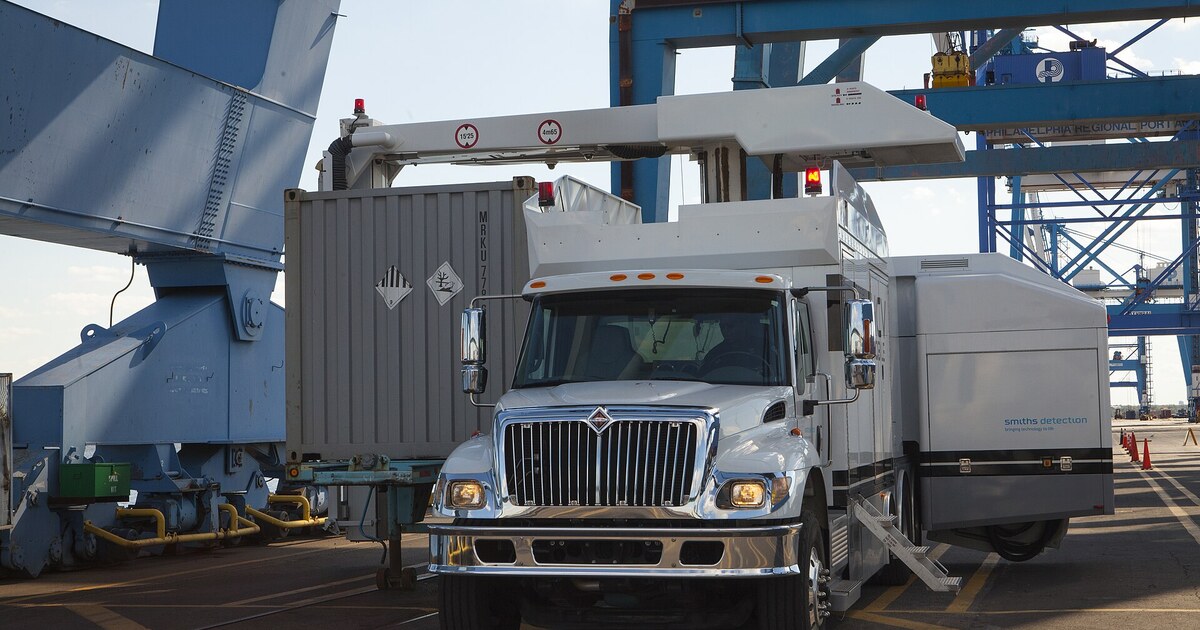
CBP non-intrusive inspection of seaport containers, Port of Philadelphia. Photo: James Tourtellotte / CBP (public domain).
When a supplier quotes you DDP, the number on the page includes duty. What the page almost never tells you is whose name is on the customs entry — and that name is the one the government will come looking for.
I have sat in on enough post-mortems to know how this ends. A seller ships three containers DDP, saves a few percent against FOB plus their own broker, feels clever. Eighteen months later they try to move to their own bond and discover they have no duty history, no entry records, and no way to prove what was declared on goods now sitting in a warehouse under their brand name.
This is not a paperwork article. It is about liability: who legally owns the consequences of an import, and how much of that you have quietly handed to someone else.
The short version: the Importer of Record is a legal role, not a logistics role. A customs bond is a guarantee to the government, not insurance for your goods. If both of those sit with your supplier or forwarder, you are not importing — you are buying goods that someone else imported and reselling them. That distinction has consequences.
1. What the Importer of Record actually is
The Importer of Record — IOR — is the party legally responsible for the accuracy of a customs entry. That responsibility is not clerical. It covers:
- the declared value, quantity and country of origin;
- the tariff classification and the duty rate that follows from it;
- whether the goods are legally admissible at all;
- payment of duty, taxes and fees;
- record-keeping for the statutory retention period;
- and the penalties if any of the above turn out to be wrong.
That is the whole list, and every item on it is personally uncomfortable. Classification errors are not corrected by an apology. A wrong origin claim is not corrected by a rebate. Duty shortfalls are collected from the IOR and, failing that, from the surety that wrote the bond.
The phrase customs uses for this is reasonable care. It means you are expected to have actually tried: to have read the entry, to have asked what the HTS code is based on, to have kept the records that support what you declared. You can delegate the filing. You cannot delegate the obligation. A broker files what you tell them to file; the liability for what was told stays with the IOR.
2. The four arrangements, and who carries the risk
China imports land in one of four structures. Only one of them is good.
| Arrangement | Who is the IOR | Duty and penalty liability | Entry record | Practical verdict |
|---|---|---|---|---|
| You, with your own entity, EIN and continuous bond | You | You — full visibility, full control | Yours, on CBP Form 7501 | Correct structure. Costs a few hundred dollars a year and one afternoon of setup. |
| DDP where the forwarder is IOR under its own bond | The forwarder or its named importer | Forwarder to CBP; you have no standing and no records | Not yours | Acceptable for one test shipment. A trap as a permanent model. |
| DDP where the supplier's trading company is IOR | Supplier or an affiliated US entity | Supplier to CBP; you inherit the product risk | Not yours, possibly not accurate | Avoid. This is the structure that produces surprise duty bills and unprovable compliance claims. |
| Borrowing a friend's, a 3PL's or an Amazon-adjacent EIN | Someone with no economic interest in your goods | They are liable, which means they will not stay liable for long | Wrong party on record | Never. This is the arrangement that ends relationships and, occasionally, companies. |
Two rows are worth noting. The middle two are common and commercially offered — DDP is sold precisely because it hides this structure. And the bottom row exists at all, which is remarkable: "use our US company's EIN, it's easier" is a sentence I have heard more than once, and it always ends with the goods being legally someone else's import.
Worth stating plainly: Amazon is not your Importer of Record. It will not act as one, it will not lend you a bond, and it will reject inbound shipments that arrive without a proper entry. Everything upstream of the fulfilment centre is your problem, not theirs.
3. What a customs bond is — and is not
A bond is a financial guarantee. A surety underwrites your obligation to pay duty, taxes, fees and penalties up to a stated amount, and CBP can claim against it without going to court first. That is the mechanism.
What it is not: cargo insurance. It does not pay you if a container is lost, damaged or delayed. It does not cover your goods, your reputation or your customer refunds. Those are separate products, and the difference matters because sellers routinely assume "we're bonded" means "we're covered." You are covered against the government's claim on your money. Nothing else.
There are two forms, and the choice is arithmetic, not preference.
| Single-entry bond | Continuous bond | |
|---|---|---|
| Scope | One entry, one shipment | All entries for twelve months, automatically renewed |
| Typical use | One-off import, sample shipment, a seller still testing | Any recurring import programme |
| How it is priced | Flat fee per entry, tiered by the value of that entry | Based on your prior-year duty, tax and fee bill, subject to a statutory minimum amount |
| Relative cost | Cheap once, expensive at volume | A few hundred dollars a year at the minimum, which is why it wins from roughly your second or third shipment |
| What it signals | Nothing | An import history CBP can see |
Note the mechanism behind continuous bond pricing: the premium is calculated from what you actually paid in duty and fees over the previous twelve months. Which means a seller who has spent two years importing under someone else's bond has no duty history to be priced against. They start at the minimum, which is fine — but they also start with no proof of anything, which is not.
Bond amounts and minimums are set by regulation and revised from time to time. Ask your customs broker for the current figure rather than working from any number you read online, including this article. The structure is durable; the digits are not.
4. ISF, and why the bond matters before the ship sails
For ocean freight to the United States, the Importer Security Filing must be filed before the cargo is loaded. It is the IOR's filing — made by them or by an agent acting on their behalf — and it is backed by the same bond.
Two failure modes recur. The first is timing: the filing goes in late because the supplier only sent the final packing details after the container was already at the terminal. The second is content: the manufacturer and seller details are filled in with whatever the supplier's salesperson typed, and nobody checks them against the commercial invoice.
Both are the IOR's problem. Liquidated damages for an ISF violation are assessed against the party on the bond, in amounts that are meaningful per violation and can multiply across a shipment. If your forwarder is the IOR under DDP, that exposure lands on them — until the day they decide your lane is not worth it and stop shipping for you, usually with containers already booked.
This is the practical reason the IOR question is not philosophical: the party holding the bond is the party who will be answering questions at the worst possible moment.
5. What you lose when the entry is not in your name
Most sellers evaluate DDP on price. The real cost is a set of capabilities you give up silently.
No ability to correct what you cannot see
Post-summary correction, protests, prior disclosures — every mechanism for fixing a bad entry belongs to the IOR. If the classification on your product is wrong and you are not the IOR, you cannot fix it. You can ask the party who is.
No duty history to defend your own numbers
When you eventually set up your own bond and your own entries, you will want to reconcile your real duty paid against your landed-cost model. Without historical entry summaries, your cost model is a guess with a decimal point.
No standing on drawback, exclusions or refunds
Duty drawback, tariff exclusions, refund claims on overpaid entries — all of these are claimed by the IOR. If a refund or exclusion applies to goods you paid for, and someone else's name is on the entry, the claim is theirs to make or ignore.
No trail when the product is questioned
Consumer product rules, labelling requirements, testing documentation — regulators and platforms increasingly ask who imported this and what did they declare. An entry history in your own name is the cleanest answer available. A story about how your supplier "handled customs" is not.
No warning before the bill arrives
Duty assessments, penalties and audit findings follow the bond. If your goods were entered under a supplier's bond with a value that was optimised rather than accurate, the assessment goes to them — and the commercial pressure comes back to you, usually as a demand to cover it, or as a supplier who is no longer willing to ship DDP.
The pattern to watch for: the DDP price looks good in year one, the supplier's bond is fine, the shipments move. Then a classification question appears, or a duty rate changes, or the supplier changes forwarders — and you discover that you cannot prove a single thing about two years of imports in your own name. The savings were real. So was the exposure; it just had not been invoiced yet.
6. Setting up your own bond: the actual sequence
This is not complicated, and it is not expensive. It is mostly administrative, which is why it gets postponed.
- Have a US business entity and an EIN. Non-US entities can be IOR in some circumstances, but it involves additional requirements including a US-based agent for service of process and a bond. If you are selling in the US market at any volume, a US entity removes an entire category of friction.
- Appoint a licensed customs broker in writing. This is the power of attorney. Until it exists, nobody can file for you. Read what you are signing — a POA authorises the broker to act as your agent on entries.
- Apply for a continuous bond through the broker or a surety. You will need the entity details, EIN and an estimated annual duty figure. Turnaround is usually days, not weeks.
- Decide the Incoterm and the consignee deliberately. FOB with you as IOR is the clean structure. DDP with a named, verifiable IOR is acceptable if you have audited it. "DDP, we handle everything" is neither.
- Require the entry summary every shipment. CBP Form 7501 tells you the HTS code used, the entered value, the duty rate, the total duty and fees. If you are not receiving it, you are not auditing your own imports.
- Keep a duty ledger. One row per entry: date, entry number, HTS code, value, duty paid. This single spreadsheet is what makes landed-cost modelling honest and what makes a bond renewal cheap.
- Retain records for the statutory period. Five years is the number most brokers will quote for entry records, but confirm the current requirement with your broker — and keep the commercial invoice, packing list, bill of lading, entry summary and proof of payment together, by shipment.
If you are currently shipping DDP and want to change structures, do it at a shipment boundary, not mid-flow. Finish the containers already booked, get the entry summaries for them if you can, then start the next booking under your own bond. Trying to switch IOR on a shipment already in transit is how cargo sits at a terminal accruing storage.
7. Nine questions that expose a DDP quote
If a supplier or forwarder offers DDP, ask these before you book. The answers — and the willingness to answer — tell you more than the price.
8. Where this connects to the rest of your cost model
Duty is not a shipping cost. It is a cost of the goods, and it sits inside your landed cost whether or not you can see it. That is why the IOR question and the landed-cost question are the same question viewed from two ends — covered in more detail in customs clearance and landed cost and in the DDP comparison in the DDP shipping guide.
There is also a strategic layer. Sellers who own their entries can respond to tariff changes — reclassifying where legitimate, restructuring origin where legitimate, timing shipments. Sellers who do not own their entries find out about tariff changes when the DDP price moves, with no ability to verify why. When duty policy shifts, as it has repeatedly in recent years, that asymmetry is worth more than the DDP discount.
And one honest caveat: DDP is not inherently wrong. For a first sample shipment, or a single test order into a market you may not pursue, using a forwarder's bond is a reasonable trade of control for speed. The mistake is treating a temporary convenience as a permanent structure, then building a product line, a brand and an inventory plan on top of it.
The Bottom Line
Every import has an Importer of Record. The only question is whether it is you. If it is not, then the duty, the classification, the admissibility decision and the penalties all belong to someone whose interests are not identical to yours — and who will eventually stop absorbing them.
The fix costs a few hundred dollars, a broker POA and one afternoon. The alternative costs whatever the assessment turns out to be, at a moment you do not choose.
Own the entry. Then argue about the price.
Build the import structure once, correctly
The China Sourcing Guide covers the full sequence — supplier verification, Incoterms, entry documents, landed cost and the compliance records to keep. Start with the free guide and see how the pieces connect.
Get the free sourcing guide