In September 2025, a client who had spent three years building a small kitchen-gadgets brand asked me to help him enter fitness with a single hero SKU: a folding home treadmill, 2.5 HP, Bluetooth app, retail target $449. He found a Dongguan supplier that described itself as a "factory with 15 years of export experience" and quoted $168 FOB with a 300-unit MOQ, promising a "quiet 55 dB motor" and a "300 lb capacity" deck. The samples impressed him: the belt ran smooth, the app paired instantly, and the fold mechanism felt solid. He wired the deposit in late October. The container sailed on November 28 and landed at Long Beach in mid-January — right on time for the resolution wave. And then January did what fitness equipment always does to the unprepared: the motor, rated for 1.5 HP continuous in the fine print, overheated and tripped thermal protection after 18 minutes of running — customers' photos of "STOP" error codes went straight to the reviews; the belt snapped on a 220 lb runner in week three because the deck was 12 mm particleboard, not the 18 mm promised; the Bluetooth app dropped connection every few minutes and drained phone batteries; and three customers reported a burning smell from the motor housing, which triggered an Amazon safety investigation that suspended the listing for six weeks — through the entire resolution wave. His return rate hit 19%, Amazon suppressed the listing, and by March he was clearing the remaining 240 units at 55% off to people who had already bought the competitor's treadmill. The root cause wasn't one bad supplier. It was a category where the motor, the frame, the belt, and the electronics are the product — and every shortcut in any one of them turns into a safety complaint, a suspension, or a recall during the eight weeks that pay for your year. That story is why this guide exists.
Exercise & Fitness is one of Amazon's largest and most durable categories — a permanent fixture in the top ten by GMV, with a demand curve that is the opposite of seasonal categories: it spikes in January when New Year resolutions hit (sales of cardio and strength equipment typically jump 30–60% over the holiday baseline), spikes again around Prime Day, and spikes a third time in November–December when fitness equipment becomes a premium gift category. US consumers spend well over $10 billion a year on home fitness equipment, and China manufactures the overwhelming majority of the physical goods, from the same hyper-specialized clusters that built the furniture, hardware, and electronics industries: Xiamen–Zhangzhou welds and assembles the cardio machines, Yongkang forges the strength hardware, Dongguan and Guangzhou build the spin bikes and home gyms, Shenzhen–Huizhou integrates the electronics, Ningbo–Wenzhou OEM the accessories, and Yiwu fills the budget tier. The margins are attractive — a $12 rubber-hex dumbbell pair retails at $49.99, an $85 magnetic spin bike at $299, a $160 folding treadmill at $449, a $90 rowing machine at $299, a $2.00 TPE yoga mat at $19.99 — because the perceived value of fitness is emotional (the new year, the new body, the home gym) and the demand is driven by moments of motivation rather than by the weather. But fitness is also the category with the most dangerous failure surface in e-commerce: the products carry motors, moving parts, high loads, and electricity, they sit in the customer's living room where a failure can injure a person or start a fire, and the platforms, regulators, and plaintiffs' bar treat them accordingly. This guide maps the clusters, the real 2026 FOB prices, the compliance stack, the verification protocols that separate a real factory from an assembler, and the sourcing calendar that decides whether you have a January at all.
Why China Still Wins Fitness (And Where the Margins Live)
China's fitness advantage is the same as its furniture, hardware, and electronics advantages: cluster manufacturing at a scale, speed, and price no other country can match — plus the ability to coordinate four factories for one product. A treadmill is not made in one place: the frame is welded in Xiamen or Yongkang, the motor is wound in Zhejiang or Guangdong, the controller and app electronics come from Shenzhen, the belt and deck from a specialist supplier, and the upholstery, packaging, and cartons from yet another layer. The Chinese supply chain handles this coordination natively; a Western buyer trying to replicate it across countries would pay 3–5x in freight and management overhead. The result is a price structure that makes the category's retail margins possible: a folding 2.5 HP treadmill at $120–280 FOB, a magnetic spin bike at $60–140, a walking pad at $55–150, a magnetic rower at $70–180, an adjustable dumbbell set at $40–90, a rubber-hex dumbbell pair at $8–20, a 20 kg cast-iron kettlebell at $18–35, an Olympic barbell at $25–50, a folding power rack at $90–220, and a 6 mm TPE yoga mat at $1.80–4.50 — price points no other manufacturing country can match in the same season.
The margin structure that makes fitness attractive in 2026:
- TPE yoga mat, 6 mm (Ningbo / Yiwu): $1.80–4.50 FOB, retails $19.99–39.99 — the category's highest-volume entry product; TPE vs PVC and the odor-free claim decide the reviews
- Resistance band set, 5-piece (Yiwu): $0.80–2.50 FOB, retails $12.99–24.99 — the volume tier; latex purity and band thickness consistency are the whole game
- Jump rope, speed (Yiwu): $0.40–1.20 FOB, retails $9.99–19.99 — bearing quality and cable durability decide the tier
- Foam roller, EPP (Ningbo / Yiwu): $1.20–4.00 FOB, retails $14.99–29.99 — foam density and surface texture decide the reviews
- Ab wheel (Yiwu): $0.50–2.00 FOB, retails $9.99–19.99 — wheel diameter and frame gauge decide stability
- Doorway pull-up bar (Yongkang): $2.00–8.00 FOB, retails $19.99–39.99 — tube gauge, grip foam, and the door-frame clamp mechanism decide safety
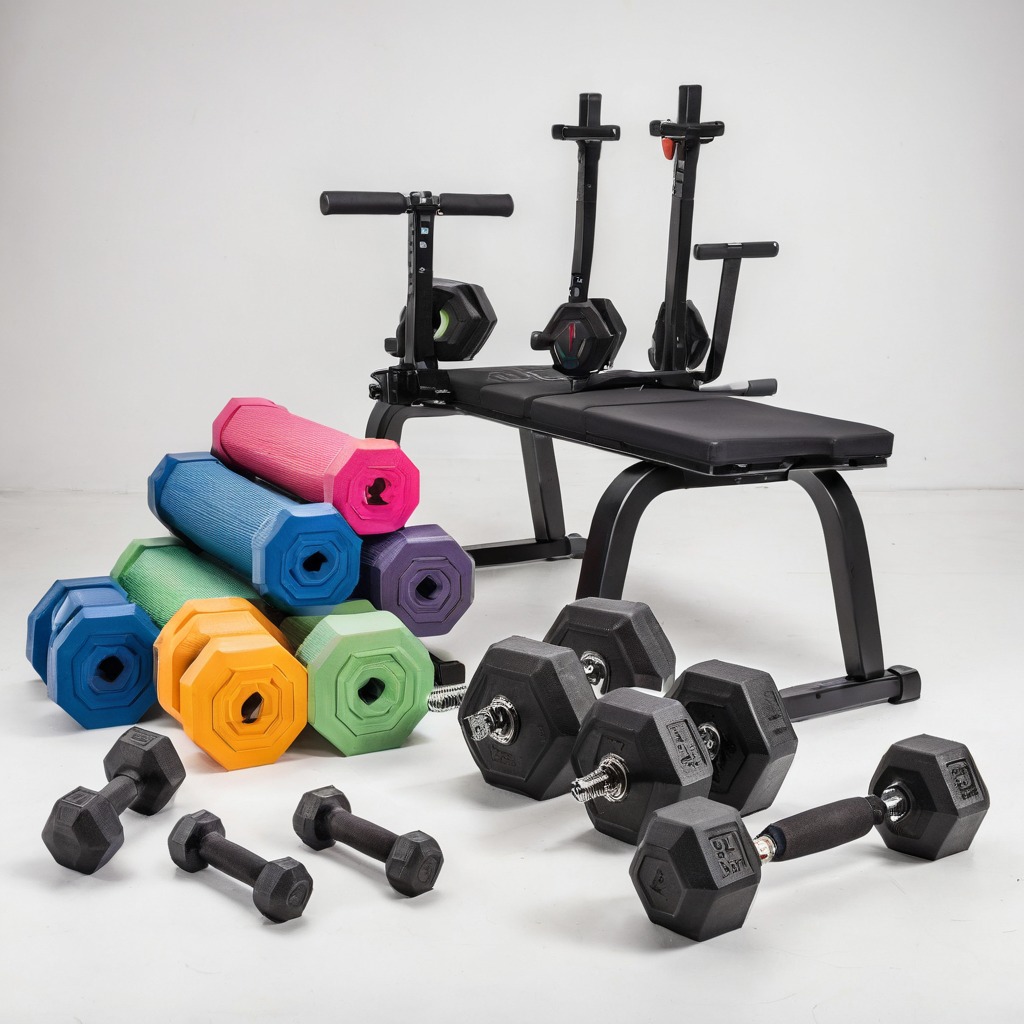
- Rubber-hex dumbbell pair (Yongkang): $8–20 FOB, retails $39.99–79.99 — cast-iron core, rubber coating quality (Prop 65 lead risk), and the hex shape decide the tier
- Adjustable dumbbell set, 24 kg (Yongkang): $40–90 FOB, retails $199–349 — the fast-growing space-saver tier; the dial/locking mechanism and weight-plate tolerance decide the reviews
- Cast-iron kettlebell, 20 kg (Yongkang): $18–35 FOB, retails $59.99–99.99 — casting quality, handle smoothness, and paint/finish decide the tier
- Olympic barbell, 20 kg chrome (Yongkang): $25–50 FOB, retails $99.99–179.99 — steel grade, sleeve rotation, and the tensile rating are the listing's life support
- Rubber bumper plates, per kg (Yongkang): $1.20–2.50/kg FOB, retails $2.50–4.00/lb — rubber quality, metal hub, and drop durability decide the tier
- Cast-iron weight plates, per kg (Yongkang): $0.80–1.50/kg FOB, retails $1.50–2.50/lb — tolerance, finish, and the center-hole fit decide the reviews
- Adjustable weight bench (Yongkang / Dongguan): $25–55 FOB, retails $99.99–199 — tube gauge, welds, and the backrest-locking mechanism are the safety-critical parts
- Folding power rack (Yongkang): $90–220 FOB, retails $299–599 — tube gauge (2 mm vs 1.5 mm), welds, and the wall-mount/floor anchor decide load capacity
- Multi-functional home gym / Smith machine (Dongguan / Yongkang): $280–650 FOB, retails $799–1,499 — the engineering tier; cable system, pulley bearings, and weight-stack design decide the tier
- Spin bike, magnetic (Dongguan / Guangzhou): $60–140 FOB, retails $249–499 — flywheel weight, magnetic vs friction resistance, and the drivetrain decide the reviews
- Folding treadmill, 2.5 HP (Xiamen / Dongguan): $120–280 FOB, retails $399–699 — the motor, the deck, the belt, and the controller are the whole product
- Walking pad, under-desk (Xiamen / Dongguan): $55–150 FOB, retails $199–399 — the fastest-growing cardio SKU; motor duty cycle and the deck thickness decide the tier
- Elliptical trainer (Xiamen–Zhangzhou): $90–220 FOB, retails $299–699 — stride length, flywheel weight, and the drive system decide the reviews
- Magnetic rowing machine (Xiamen / Ningbo): $70–180 FOB, retails $249–499 — rail construction, seat rollers, and the resistance mechanism decide the tier
- Smart connected rower (Xiamen / Shenzhen): $150–380 FOB, retails $499–999 — the premium tier; water vs magnetic resistance, the app, and the electronics are the engineering
- Vibration plate (Ningbo): $18–50 FOB, retails $79.99–149.99 — motor quality, amplitude consistency, and platform stability decide the tier
- Massage gun (Ningbo / Shenzhen): $12–40 FOB, retails $49.99–129.99 — motor stall torque, battery (UN 38.3), noise, and the attachment quality decide the reviews
- Suspension trainer, TRX-style (Ningbo / Yiwu): $3–10 FOB, retails $29.99–59.99 — webbing quality and the cam-buckle mechanism decide safety
- Weighted vest, 20 lb (Yongkang / Ningbo): $8–25 FOB, retails $39.99–79.99 — the weight-fill system and strap quality decide the tier
- Battle rope, 50 ft (Yongkang / Yiwu): $8–25 FOB, retails $39.99–79.99 — rope material and the end-handle construction decide durability
- EVA foam floor tiles, 24 sq ft (Yiwu): $6–15 FOB, retails $39.99–69.99 — EVA density, thickness, and the interlocking tolerance decide the tier
- Ankle/wrist weights, pair (Yiwu): $1.50–5.00 FOB, retails $14.99–29.99 — the fill system (sand vs iron) and the strap quality decide the reviews
- Balance board (Yiwu / Ningbo): $3–10 FOB, retails $19.99–39.99 — board construction and the pivot mechanism decide the tier
- Smart jump rope, connected (Yiwu / Shenzhen): $3–10 FOB, retails $19.99–39.99 — the counter electronics, battery, and app decide the reviews
The catch: fitness margins are only real if your return rate stays under 5% — and in this category returns are driven by functional failures that surface during the demand spike when you cannot restock. A burned-out motor, a snapped belt, a collapsed bench, a frayed cable, a dead battery, or a failed FCC check is not a "not my style" return; it is a one-star review with a photo, a suppressed listing, an Amazon safety investigation, and — in the worst cases — a recall or a lawsuit, all during the eight weeks that pay for your year. A $3 saving on the motor, $2 on the controller, $1.50 on the tube gauge, $0.80 on the belt, $0.60 on the rubber coating, or $0.50 on the battery costs the factory pennies and costs you the entire category.
China's Fitness Equipment Clusters: Who Makes What, and Where to Source
Fitness is a multi-cluster category — the cardio machines, the strength hardware, the spin bikes, the smart electronics, the accessories, and the budget tier each have their own capital, and one finished product often passes through three or four clusters. Match your product to its cluster and you get factory-direct pricing with real production depth; mismatch it and you're paying a trading company's markup on goods that were coordinated, not made, by the company you're paying. Here's the map:
| Cluster | Specialty | FOB Range (2026) | Typical MOQ |
|---|---|---|---|
| Xiamen–Zhangzhou (Fujian) | The cardio capital of China: a large share of the world's treadmills, ellipticals, exercise bikes, and rowing machines is welded, wound, and assembled here, with a deep base of factories that OEM for global fitness brands. The default for anything with a motor, a belt, and a console | $55–380 | 100–1,000 pcs |
| Yongkang (Zhejiang) | The Hardware Capital of China and the strength-equipment axis: dumbbells, kettlebells, barbells, plates, benches, racks, pull-up bars, and every forged or pressed steel part in the gym. The default for anything made of steel that gets loaded, dropped, or lifted | $2–650 | 500–5,000 pcs |
| Dongguan (Guangdong) | The home-gym and spin-bike belt: magnetic spin bikes, folding treadmills, multi-functional home gyms, and Smith machines, plus the upholstery and foam work that goes with them. Strong at full-machine assembly and container consolidation | $60–650 | 200–1,000 pcs |
| Guangzhou (Guangdong) | Spinning bikes, budget treadmills, and fitness accessories at scale, with dense trading infrastructure around the Canton Fair and the wholesale markets. The default for mid-tier cardio with volume pricing | $30–200 | 300–2,000 pcs |
| Shenzhen–Huizhou (Guangdong) | The smart-fitness electronics axis: connected rowers and bikes with app ecosystems, smart jump ropes, massage guns, and the controllers, Bluetooth modules, and firmware that make equipment "smart." The default for anything with an app, a screen, or a battery | $12–400 | 300–1,000 pcs |
| Ningbo–Wenzhou (Zhejiang) | The fitness-accessory OEM belt: vibration plates, massage guns, foam rollers, yoga mats, suspension trainers, weighted vests, and the plastic/foam/rubber goods around the gym. Strong mold base and export logistics | $1–60 | 500–5,000 pcs |
| Yiwu (Zhejiang) | The budget tier and impulse tier: resistance bands, jump ropes, ab wheels, ankle weights, EVA tiles, and the low-cost accessories that move by the container — plus thousands of trading booths that forward orders to factories they don't own | $0.30–8.00 | 1,000–100,000 pcs |
The cluster logic matters more in fitness than in most categories because of what "factory-direct" hides: a treadmill "factory" in Dongguan may weld the frame and buy the motor from a Zhejiang winder, the controller from a Shenzhen board shop, the belt from a specialist, and the console from another assembler. That is normal and fine — the risk is when the supplier you are paying has none of those lines and is simply coordinating them at a markup. Ask who welds, who winds, who assembles the electronics, and who sews the upholstery; the answer tells you who is really in charge of quality, and it tells you where your QC checks need to go.
The Fitness Compliance Stack: US, EU, and Platform Rules
United States
- UL 1647 (motor-operated massage and exercise machines). The primary US safety standard for motorized exercise equipment — treadmills, ellipticals, exercise bikes, vibration plates, massage guns with motors, and smart equipment with powered mechanisms. It covers electrical safety, mechanical hazards, temperature limits, and fire safety. A real UL 1647 file names the actual model and is verifiable online; "CE only" is not a substitute in the US.
- ASTM F2115 (treadmills) and ASTM F2276 (stationary training equipment). The US performance standards for treadmills (F2115) and stationary training equipment broadly (F2276 — the umbrella standard that covers bikes, ellipticals, rowers, and strength machines). Both cover structural integrity, stability, pinch points, and user safety; retailers and Amazon expect documentation showing the product was evaluated against them.
- ASTM F2571 (sport simulators). Covers sport-simulator products — in the fitness space this matters for interactive/connected equipment that simulates sport motion. Verify whether your product falls under it before you list.
- FCC Part 15. Any product with electronics that emit RF — Bluetooth app connectivity, smart consoles, digital displays — needs FCC Part 15 certification (typically SDoC or certification depending on the module). The FCC ID must be real and searchable in the FCC database; a console with no FCC ID is an Amazon suspension waiting to happen.
- UN 38.3 (batteries). Massage guns, smart jump ropes, and connected equipment with lithium batteries need UN 38.3 test reports naming the exact cell and pack — required for air freight and enforced by Amazon. Verify the report matches the actual battery, not a lookalike.
- Prop 65. Rubber coatings on dumbbells and kettlebells, PVC in mats, and electronics all carry lead/phthalate risk under California Prop 65. A missing warning on a coated-weight product is a real enforcement and suspension risk in 2026 — and the coating is the most-faked material in the strength category.
- CPSIA/CPC (youth-oriented equipment). Kids' fitness products — junior dumbbells, kids' yoga mats, playground-style equipment — are children's products and need CPCs and third-party testing under CPSIA. Assume youth SKUs are toys until proven otherwise.
European Union
- EN 957 series (stationary training equipment). The EU standard family: EN 957-1 (general safety requirements), EN 957-2 (strength equipment), EN 957-5 (pedal-crank training equipment — exercise bikes), EN 957-6 (treadmills), EN 957-7 (rowing machines), EN 957-8 (benches), and EN 957-9 (elliptical trainers). Products sold in the EU are expected to meet the relevant part with a technical file behind the CE mark.
- CE (Machinery Directive + LVD + EMC). Most powered fitness equipment falls under the Machinery Directive (2006/42/EC) and/or the Low Voltage Directive, with EMC for electronics — a CE mark without the technical file, risk assessment, and declarations is a market-surveillance failure waiting to happen.
- RoHS and REACH. Electronics must comply with RoHS; REACH restricts phthalates in PVC mats and soft plastics, PAHs in rubber, and heavy metals in coatings. Test the actual materials — the yoga mat and the dumbbell coating are the two classic failures.
- GPSR. Every product sold in the EU needs an EU responsible person and traceable labeling — fitness equipment is squarely in scope. Budget ~$500–1,000/year for the EU rep service.
- UK. Goods sold into Great Britain need UKCA marking (or CE accepted under current transition rules), UK REACH alignment, and GPSR-equivalent labeling.
Platform Rules (Amazon, Walmart, TikTok Shop)
- Amazon gates exercise equipment — treadmills, ellipticals, exercise bikes, and other motorized equipment — and asks for safety documentation (UL 1647, ASTM F2115/F2276, FCC, UN 38.3 where applicable) at audit. The audit window is December–January, right when you need the listings live for the resolution wave; listings without verifiable documentation get suppressed at the worst possible moment.
- Safety complaints are policed by both Amazon and the CPSC — a "treadmill stopped mid-run and I fell" or "bench collapsed during use" review with a photo is the fastest way to lose a fitness listing, and a pattern of them triggers a recall-style investigation. The plaintiffs' bar is active on home fitness injuries; a real liability policy and real test files are part of the product.
- Prop 65 enforcement on coated fitness weights is active on Amazon through both California's private-attorney general bar and Amazon's compliance flags — a missing warning on a rubber-hex dumbbell is a real suspension risk in 2026.
- Walmart and TikTok Shop enforce the same documentation and gating flows; a compliance file built once covers all three.
⚠️ The Fake Certificate and Downgraded Motor Problem
In fitness, the certificate on the listing and the motor under the hood are both part of the product — and both are the most-faked parts of it. Real UL 1647 files are listed with a file number you can verify online; real FCC IDs are searchable in the FCC database; real UN 38.3 reports name the exact cell and pack; real EN 957 test reports carry the lab, the model, and the date. Meanwhile, the classic downgrades are all measurable: a "2.5 HP continuous" motor that is 1.5 HP with a different sticker, a controller with no-name MOSFETs and no thermal protection, a 12 mm deck sold as 18 mm, 1.0 mm tube sold as 2.0 mm, a 4 kg flywheel sold as 8 kg, a 2000 mAh battery sold as 3000 mAh, and rubber coating with lead where the spec sheet says "lead-free." Before you place an order, verify every certificate and every spec independently — measure the motor's amp draw and temperature under load, check the deck thickness with a caliper, weigh the flywheel, test the battery capacity — and budget $500–5,000 per SKU family for your own third-party testing through an accredited lab. It is the cheapest insurance in the category, and it makes your listings suppression-proof during the eight weeks that pay for your year.
The Six Tests That Separate Real Fitness Factories from Assemblers
Quality in fitness lives in the motor, the frame, the belt, the electronics, and the materials — none of which your listing photos can show. Run these tests on samples in the summer, then spot-check production units:
- The motor and electrical test. Run the treadmill, walking pad, or bike for 60–90 continuous minutes at maximum speed and incline and measure: motor housing temperature (should stay well under the insulation class limit), amp draw vs the nameplate rating, noise in dB (the "55 dB" claim is a spec you can measure), and thermal-protection behavior. Then open the controller: check for branded MOSFETs, a real heatsink, thermal protection, and clean PCB soldering. The motor and controller are the two components where every downgrade is invisible until the machine stops mid-run.
- The structural load test. Load every bench, rack, and machine to 125% of its rated capacity for 24 hours and check for sag, weld cracks, and hinge/pivot wear; apply dynamic loads (repeated sit-ups, drops on a bench) and check the welds with a magnifier — cosmetic surface welds vs full-penetration welds are the difference between a bench that lasts a decade and one that collapses in month four. Measure the tube gauge with a caliper (2.0 mm vs 1.5 mm vs 1.0 mm is a 40% strength difference) and verify the powder-coat thickness on outdoor-adjacent and garage equipment.
- The belt and drive test. For treadmills and walking pads: check belt alignment and tracking over 30+ minutes, measure speed accuracy against a tachometer (±0.1 mph on the display is the standard), verify the deck thickness (18 mm vs 12 mm changes the impact absorption and the lifespan), and run a 250 lb user-weight simulation. The belt-deck-motor trio is the treadmill's whole product.
- The cable and pulley cycle test. For cable machines, home gyms, and Smith machines: cycle every cable 10,000+ times at load and check for fraying at the pulley, bearing wear, and pinch points; verify the cable's rated breaking strength and the pulley's groove profile. A snapped cable under load is a lawsuit, not a return.
- The materials and finish test. Check the yoga mat material (TPE vs PVC — PVC carries phthalate and odor risk), test the rubber coating on dumbbells and kettlebells for lead (Prop 65) and for adhesion (does it peel after a month?), verify cast-iron quality on kettlebells (porosity = hidden weakness), and check the foam density on rollers and floor tiles. The coating and the foam are where the cheapest downgrades hide.
- The electronics and battery test. For smart equipment: verify the FCC ID in the FCC database, test the Bluetooth/app pairing and connection stability over 30 minutes, verify the battery's UN 38.3 report matches the actual cell and capacity (discharge test), and check data privacy — what the app collects and where it sends it. Smart fitness is the fastest-growing tier and the fastest way to collect a compliance suspension.
The 8-Step Fitness Sourcing SOP (With the Demand-Wave Calendar)
- Pick your lane and your deadline. Start with accessories and yoga — light compliance, fast cash cycle. Graduate to strength equipment with a steel-spec and load-testing budget, to cardio with a motor and UL/ASTM/EN 957 budget, and to smart equipment only with an electronics, FCC, battery, and app budget. Then set the calendar: for the January resolution wave, containers need to sail by October–November, which means sourcing decisions in May–July, samples and tests in June–August, production in August–October, and freight booked before production finishes. For the Q4 gifting wave, production runs June–August and containers sail August–September. Prime Day inventory runs on the Q1 calendar — book it in February–March.
- Match the product to its cluster. Cardio machines to Xiamen–Zhangzhou; strength hardware to Yongkang; spin bikes and home gyms to Dongguan and Guangzhou; smart equipment to Shenzhen–Huizhou; accessories and massage guns to Ningbo–Wenzhou; budget tier to Yiwu. A supplier outside the right cluster is either a trader or paying someone else's overhead — and for fitness specifically, ask who winds the motor, who welds the frame, who builds the controller, and who sews the upholstery, because the answer tells you who is really in charge of quality.
- Vet the factory. Business license, export history, brand customers, the names of their motor, controller, belt, and steel suppliers, their certification files (UL 1647 numbers, FCC IDs, UN 38.3 reports, EN 957 test reports, CPCs), and a video call onto the actual production floor. In fitness, confirm the welding, motor-mounting, electronics, and assembly lines exist — the category attracts more coordinators than any other in China.
- Order 2–3 samples from 2+ factories and run the six-test battery in the summer. The motor test, the structural load test, the belt and drive test, the cable cycle test, the materials test, and the electronics test. This is the window that decides whether your January survives.
- Run the compliance tests on the samples. UL 1647 and ASTM F2115/F2276 for powered equipment, FCC Part 15 for electronics, UN 38.3 for batteries, Prop 65 for coated weights and PVC, EN 957 and CE (Machinery/LVD/EMC) for the EU, and CPCs for youth SKUs — through accredited labs, on the samples, in the summer rather than after the container sails.
- Negotiate MOQ and the container strategy. Fitness economics run on container utilization and spec standardization: combine 30–50 SKUs in one container, standardize on one motor, one controller, one tube gauge, one coating system, one cable, one battery, and one app platform across your whole line, and own your molds and your motor tooling on the repeatable SKUs. Fewer platforms mean fewer failure modes and one certification stack to renew.
- Third-party QC on every batch. Inline checks at welding, motor mounting, electronics, assembly, and packing, plus final random inspection at AQL 2.5 with random motor-run, load, belt, cable, and coating spot checks. Never ship fitness equipment without final inspection — the failures are invisible until they are under a customer's feet, hands, or living-room ceiling.
- Book freight and lock the sailing date before production finishes. October–November is peak season out of China — the January inventory for every category collides with the Q4 rush, and vessel space is the constraint. Confirm the booking, the sailing date, and the transit time in writing; the seller with a locked booking has a January while the seller with "a forwarder somewhere" watches the resolution wave from a warehouse.
Fitness is one of the biggest and most durable categories in e-commerce when you respect its physics: $10+ billion in annual US spending, three demand waves a year, and margins that make a $12 dumbbell pair into a $49.99 sale and a $160 treadmill into a $449 sale. But it is also the category where the product carries a motor, high loads, and electricity into the customer's living room, where the spec sheet is the product, and where every shortcut — the undersized motor, the no-name controller, the 12 mm deck, the 1.0 mm tube, the cosmetic weld, the lead-laden coating, the unverified FCC ID, the mismatched UN 38.3 report — turns into an injury, a review, a suspension, or a recall during the eight weeks that pay for your year. The sellers who win January aren't the ones who found the cheapest quote; they're the ones who ran the motor for 90 minutes, loaded the bench to 125%, cycled the cable ten thousand times, caliper-checked the deck and the tube, lab-tested the coating, verified every UL file and FCC ID and UN 38.3 report online, and locked the sailing date before the container was full. Do that, and the 40–70% gross margins this category offers become yours to keep — through the wave that pays for your year.