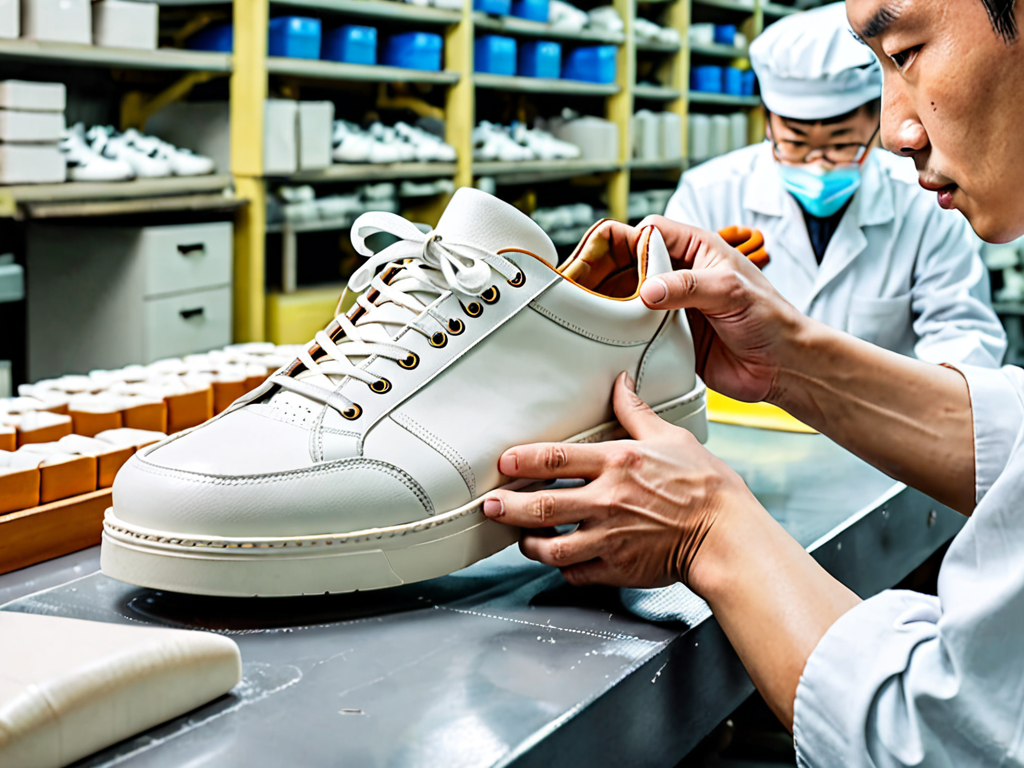
In February 2026, an Amazon seller I advise ordered 2,000 pairs of "genuine leather" men's loafers from a Guangzhou trading company at $11.80 FOB. The listing photos were gorgeous, the samples were perfect — real leather, beautiful stitching. The production run arrived in May: 1,900 pairs with uppers that were 70% PU-coated split leather, outsoles that delaminated from the upper after 40 wears, and a size grading so inconsistent that a "US 10" measured anywhere from 9.6 to 10.7 inches. The return rate hit 27% in the first six weeks. Amazon suppressed the listing, the supplier ghosted him, and the chargebacks from the payment processor ate what was left of his margin. He had skipped exactly three steps: origin-cluster sourcing, a written material spec, and production-unit verification. This guide is the version of that lesson you don't have to pay $48,000 to learn.
Footwear is one of the last great margin categories in e-commerce — 60–75% gross margins are normal on a $2.50 FOB canvas sneaker that retails for $39.99 — and China still manufactures roughly 60% of the world's shoes. But it's also the category where material fraud, construction shortcuts, and sizing chaos are most punishing, because the product literally carries your brand's name on the inside of the collar. Every shoe your customer wears for a year is walking advertising; every shoe that falls apart in a month is walking proof you don't know what you're doing. This guide closes that gap.
Why China Still Wins Footwear (And Where the Margins Actually Live)
Vietnam has overtaken China in export volume for athletic footwear specifically — Nike and Adidas shifted a huge share of production there — but China remains the world's footwear factory for a reason that has nothing to do with labor cost: the complete supplier ecosystem. In a single hour of driving in Jinjiang you can find the outsole maker, the insole maker, the last maker, the upper stitching workshop, the adhesive supplier, the laces factory, and the box printer. That ecosystem is what makes China's 30–45 day development-to-sample cycles and $2–15 FOB prices possible. Vietnam can make shoes; China can make your shoe — with your last, your materials, your branding, in your MOQ, in weeks.
The margin structure that makes footwear attractive in 2026:
- Canvas sneakers (vulcanized): $2.50–4.50 FOB, retails $29.99–49.99 — the classic entry-level Amazon and Shopify category
- Basic athletic/casual sneakers (cold cement): $5.50–9.50 FOB, retails $49.99–79.99
- Genuine leather dress shoes (Wenzhou): $16–28 FOB, retails $89–159
- Women's fashion heels (Guangzhou/Chengdu): $6.50–12 FOB, retails $39.99–69.99
- EVA/rubber slippers and sandals: $1.20–3.80 FOB, retails $14.99–29.99 — highest margin-per-dollar in the category
The catch: those margins are only real if your return rate stays under 5–8%. Every percentage point above that comes directly out of gross margin. And footwear return rates are driven by exactly three things — fit, materials, and construction — which are precisely the three things Chinese factories will cut corners on if your spec sheet leaves any room to.
China's 8 Footwear Manufacturing Clusters: Who Makes What, and Where to Source
Unlike most product categories, footwear has almost no "generalist" factories — every major cluster specializes, and the specialization is deep. Here's the map:
| Cluster | Specialty | FOB Range (2026) | Typical MOQ |
|---|---|---|---|
| Wenzhou (Zhejiang) | Leather shoes, men's dress shoes, women's fashion leather, boots — the "Chinese Italy" | $14–30 | 600–1,200 pairs |
| Jinjiang–Quanzhou (Fujian) | Athletic shoes, running shoes, basketball shoes, sports sandals — 40%+ of world sports shoes | $5.50–14 | 1,000–3,000 pairs |
| Putian (Fujian) | Sneakers — technically superb, but replica/grey-market risk is endemic; verify suppliers hard | $4.50–9 | 500–1,500 pairs |
| Guangzhou Baiyun (Guangdong) | Women's fashion shoes, heels, sandals, flats — fastest development cycles, huge export trade | $5–12 | 300–800 pairs |
| Dongguan Houjie (Guangdong) | Premium OEM for Western brands, high-end leather and designer-quality construction | $18–40 | 800–2,000 pairs |
| Chengdu (Sichuan) | Women's shoes — one of the world's largest women's shoe bases, strong on fashion leather and boots | $6–13 | 600–1,000 pairs |
| Chongqing Bishan | Sneakers and casual shoes — the rising cluster absorbing Fujian overflow, aggressive pricing | $4.50–8.50 | 1,000–2,000 pairs |
| Fujian/Guangdong coastal (Jinjiang, Chaoshan) | EVA/rubber slippers, sandals, beach shoes, injection-molded clogs | $1.20–3.80 | 2,000–5,000 pairs |
A quick rule of thumb: if your product is a leather shoe, go to Wenzhou or Chengdu. If it's athletic, Jinjiang–Quanzhou. If it's fashion-forward women's footwear with short lifecycles, Guangzhou Baiyun. If it's premium private-label for a brand that needs boutique quality, Dongguan Houjie. And if a quote arrives from a city that isn't the cluster for your product type, that's a trading company — negotiate accordingly (15–30% price padding is standard) or walk.
⚠️ The Putian Problem: Sourcing Sneakers Without Getting Burned
Putian makes some of the best-constructed sneakers in the world — which is exactly why it's also the world's replica capital. Estimates put 70%+ of Putian's output in grey-market or replica territory, from "original factory" Nike to unbranded lookalikes sold as branded on marketplace platforms. That doesn't mean you can't source legitimate private-label sneakers there — thousands of honest OEM factories exist — but it means your due diligence must be stricter: verify the business license and export records, visit or video-call the factory floor, confirm they hold legitimate brand licenses (ask to see them), and get a written warranty in the contract that the goods are original designs with no third-party IP. Sourcing unbranded lookalikes from Putian is how sellers end up with seized containers, Amazon IP complaints, and trademark lawsuits.
2026 FOB Cost Benchmarks: 22 Footwear Categories
Real FOB prices (ex-factory, per pair, at 500–2,000 pair MOQs, mid-2026, from origin-cluster factories):
| Category | FOB Range | Typical Construction |
|---|---|---|
| Canvas low-top sneakers | $2.50–4.20 | Vulcanized |
| Canvas high-tops | $3.00–5.00 | Vulcanized |
| Basic knit/casual sneakers | $4.50–7.00 | Cold cement |
| Running shoes (EVA midsole) | $6.50–12.00 | Cold cement |
| Basketball/training shoes | $8.00–15.00 | Cold cement |
| Leather sneakers (genuine leather) | $10.00–18.00 | Cold cement |
| Men's dress shoes (genuine leather) | $16.00–28.00 | Cemented/Blake |
| Men's leather loafers | $12.00–20.00 | Cemented |
| Women's high heels (PU) | $5.00–9.00 | Cemented |
| Women's high heels (leather) | $10.00–18.00 | Cemented |
| Women's flats/ballet shoes | $3.50–6.50 | Cemented |
| Ankle boots (PU) | $7.00–12.00 | Cemented |
| Leather Chelsea boots | $14.00–24.00 | Cemented/Goodyear |
| Winter boots (fleece-lined) | $8.00–14.00 | Cemented |
| EVA slippers | $1.20–2.20 | Injection |
| Rubber/EVA sandals | $1.80–3.50 | Injection |
| Slide sandals (foam) | $2.00–4.00 | Injection |
| Sports slides (athletic brand style) | $3.00–5.50 | Injection |
| Kids' sneakers (canvas) | $2.00–3.50 | Vulcanized |
| Kids' school shoes (leather) | $5.00–9.00 | Cemented |
| Work/steel-toe safety shoes | $9.00–16.00 | Injection/cemented |
| Hiking/trail shoes | $8.00–15.00 | Cold cement |
Two pricing realities worth internalizing. First, the spread between clusters for the same shoe is real: the same basic knit sneaker is $4.50–5.00 in Jinjiang, $5.50–6.50 from a Guangzhou trading company, and $6.00–7.00 from a Shenzhen agent — you pay for proximity to the port unless you negotiate. Second, when a quote comes in 20%+ below the cluster norm, the factory has already decided where the money comes back: thinner outsole, cheaper adhesive, split leather, or a shorter production run with looser QC. There is no free lunch in footwear pricing — there's only a hidden bill.
Construction Methods: The Three Ways Shoes Are Built (And How Each Can Fail You)
1. Vulcanized (Vulc)
The classic canvas sneaker method: the upper is lasted onto the outsole, and the whole shoe is cured in an autoclave so the rubber outsole chemically bonds to the upper. Used for All Stars-style canvas shoes, skate shoes, and retro classics. Advantages: outstanding flexibility and durability of the bond, iconic look, low cost. Failure modes: under-curing produces soles that crack at the toe crease within weeks (test with the flex test below); the white rubber foxing band discolors if the factory uses cheap pigment; and vulcanized production is slower, so MOQs tend to be higher. Key spec: cure temperature/time, rubber compound (natural rubber content), foxing band material.
2. Cold Cement (Cemented)
The workhorse method for 90%+ of athletic, casual, and fashion shoes: the upper is lasted on the last, the outsole is prepared (roughened, primed), and adhesive bonds them — no heat. Advantages: fastest production, lightest weight, most design freedom, lowest cost at scale. Failure modes: delamination is the #1 footwear defect in e-commerce — caused by skipping the primer, using cheap solvent-based adhesive, or bonding on a humid day. The factory saves $0.15–0.30 per pair on adhesive, and you eat a 15–25% return rate. Key spec: adhesive type (PU-based, brand-specified), surface preparation steps, and a written requirement that the factory performs a peel test on production units.
3. Injection (Direct Injection / Molded)
The outsole (EVA, TPU, or PU) is injected directly onto the lasted upper in a mold, or the entire shoe is molded in one piece. Used for Crocs-style clogs, sandals, slippers, safety shoes, and increasingly for performance sneakers (the "molded" wave). Advantages: no adhesive failure possible (the bond is molecular), waterproof options, extremely low labor cost, great for beach/outdoor products. Failure modes: worn molds leave sharp flash lines that cut feet (the classic cheap-slide problem); material substitution from TPU to cheap EVA changes the feel and durability; and color inconsistency between batches. Key spec: material grade (EVA density, TPU hardness), mold maintenance, and flash removal standard.
Ask every factory three questions before requesting a quote: What construction method do you recommend for this design, and why? What adhesive/material grades do you use as standard? Can you show me a peel or flex test report from your last production run? The factories that answer precisely are the ones doing real manufacturing. The ones that say "don't worry, we make good shoes" are trading companies or workshops that will make your life expensive.
Materials: The Substitution Playbook (And How to Catch Every Swap)
Footwear material fraud is not exotic — it's systematic, because the price differences are huge and the customer can't see the difference for months. Here's the playbook:
⚠️ The 6 Most Common Material Substitutions
- PU or split leather labeled "genuine leather": PU-coated split leather looks like full-grain in photos and even in hand — until it peels. This is the most common fraud in the entire category. Catch it with the water-drop test (genuine leather absorbs water within 30–60 seconds; PU-coated surfaces bead it), the burn test (leather smells like hair and chars; PU melts and smells like plastic), and a cross-section cut (real leather shows fibrous layers; split + coating shows a thin coated layer over a compressed fiberboard-like core).
- Rubber outsole swapped for EVA: EVA is cheaper, lighter, and less durable. A "rubber" outsole that a magnet doesn't stick to and that floats in water is EVA. Density test: rubber is 1.1–1.4 g/cm³; EVA is 0.05–0.15 g/cm³ (it floats). If your spec says rubber and the production outsole floats, you were swapped.
- Cotton canvas replaced with polyester: Cotton breathes, breaks in, and ages well; polyester pills, holds odor, and doesn't break in. Burn test: cotton burns to ash; polyester melts into a hard bead. This swap happens constantly on "canvas" sneakers.
- "Full-grain" that is corrected grain: The factory buffs the surface and paints on a grain pattern. Check with a loupe — corrected grain shows a uniform painted texture; full grain shows natural pore variation. Also check the flesh side: real full grain has a suede-like back.
- Cheap adhesive / skipped primer: Not visible at all — which is why delamination is the #1 invisible defect. Your only defense is the peel test on production units and a written adhesive spec.
- Lining and insole materials with banned substances: Foam and lining materials sourced from the cheapest tier often contain phthalates (banned in kids' products under CPSIA, restricted under REACH) or lead in pigments. The factory doesn't even know — their material supplier swapped it. Lab testing of production units is the only answer.
The verification battery that catches all of this costs $300–600 per style if you bundle tests, or less than $100 if you do the physical tests yourself (burn, water-drop, density, magnet, cross-section) at the factory or on arrival:
- Genuine leather: water-drop, burn, cross-section, plus lab verification (the leather content claim on your listing is a legal statement in both the US and EU)
- Outsole compound: density/float test, Shore hardness (A scale for rubber/TPU), acetone rub test (PU softens; rubber doesn't)
- Upper material weight: weigh per square meter against spec — a "12 oz canvas" that arrives at 8 oz is a different product
- Sole adhesion: peel test (pull the outsole from the upper at the toe and heel; record force and failure mode — clean adhesive failure = bad bonding)
- Flex durability: SATRA TM92-style flexing (bend the shoe at the ball joint 30,000–50,000 times; check for cracking, delamination, and upper damage)
- Lab compliance: lead (CPSIA/Prop 65), phthalates (CPSIA/REACH), chromium VI in leather (REACH entry 47 — this one gets European containers rejected at customs)
Compliance Stack: US, EU, and Amazon Requirements for Shoes
United States
- CPSIA: Shoes for children under 12 must meet lead limits (100 ppm in accessible parts) and phthalate limits (8 phthalates restricted to 0.1% in accessible parts of child care articles and toys). Children's shoes require a CPC (Children's Product Certificate) based on third-party lab testing. This is the #1 compliance failure for kids' shoe imports — thousands of listings get suppressed every year for missing CPCs.
- California Prop 65: Lead, phthalates (DINP/DEHP), and certain azo dyes in footwear have triggered thousands of Prop 65 lawsuits against online sellers. The settlement math (fines up to $2,500/day per violation, usually settled for $10k–50k per SKU) makes this the most expensive compliance trap in the category. Test and get certificates for lead, phthalates, and heavy metals in dyes and pigments.
- FTC labeling: Country-of-origin labeling ("Made in China") on the shoe and/or box is mandatory; material/content claims (leather, genuine leather, waterproof) must be truthful and substantiated — the FTC has pursued footwear brands for "genuine leather" claims on PU shoes.
- CPSC tracking labels: Children's shoes must have permanent tracking labels (manufacturer, date/location of production, batch) — required even on the sole lining.
- Flammability: General footwear is not subject to the Flammable Fabrics Act, but slippers marketed as sleepwear-adjacent or certain novelty products can trigger it — check before listing "cozy" products.
European Union / UK
- REACH: Chromium VI in leather (entry 47) — limit 3 mg/kg, one of the most-enforced REACH restrictions on footwear; phthalates in plastics (entries 51–52); PAHs in rubber/plastic soles (entry 50, relevant for sports slides); nickel in metal parts (entry 27); and the 2023 PFAS restriction roadmap affects waterproofing treatments on outdoor footwear — EU-market sellers need a PFAS-free supply chain for waterproof claims.
- GPSR (General Product Safety Regulation): In force since December 2024 — every product sold in the EU needs a responsible person (EU-based), traceability info, and visible safety warnings. Your factory's CE-style documentation won't help; this is your obligation as the brand.
- UK: Same REACH regime via UK REACH, plus UK GPSR equivalent — and note that UK/EU requirements now diverge on paperwork, so a single "EU-compliant" certificate doesn't automatically cover the UK.
Amazon Footwear Requirements
Amazon treats footwear as a moderately gated category: you'll need brand approval for most shoe categories (trademark + invoices from the manufacturer), and compliance documents (CPC for children's shoes, Prop 65 certificates on request, test reports) can be demanded at any time. The killer is the return and chargeback regime: Amazon's return window and A-to-z claims mean a delamination or sizing problem becomes an immediate account-health hit. In 2025–2026, Amazon also began requiring "fit" attributes (size, width, arch type) to be populated accurately — sellers with inconsistent size grading get flagged for listing quality. Treat compliance and sizing as Amazon account health, not paperwork.
Sizing and Grading: The Margin Killer Nobody Budgets For
Here's the uncomfortable truth: most Chinese footwear factories grade sizes using Chinese foot data and their own lasts, which run shorter and narrower than US lasts in most styles. A US men's 10 from a Wenzhou factory is frequently a 9.5 in practice — and a women's 8 from Guangzhou Baiyun can run a full size small. Your customer doesn't know or care why; they just return it.
The fix is a written size-grade spec and a verification protocol:
- Define your size run and grade: For every half size, specify heel-to-toe insole length (e.g., US M 9 = 27.3cm, 9.5 = 27.8cm, 10 = 28.3cm), ball girth, and instep height. This becomes part of the PO contract.
- Order graded samples: At minimum 3 sizes spanning your run (7/9/11 for men, 6/8/10 for women). If a factory says they only make one-size samples, that's your answer about their QC culture.
- Measure the production units: Your QC inspector measures insole length on a random sample (AQL 2.5) against the grade spec, with a ±1.5mm tolerance. Sizes outside tolerance get rejected at source — where rejection costs you nothing, not at the customer's door where it costs you everything.
- Publish honest fit data: Put the measured insole length in your listing (size chart with cm), and note "runs true to size / half size small" based on real wear tests. Sellers who do this cut size-related returns by half.
MOQs: The Real Math Behind "300 Pairs"
Footwear MOQs confuse sellers because they're quoted in pairs, but the real constraint is per-size-per-color. A 300-pair MOQ on a 6-size, 2-color run is 25 pairs per size-color combination — which is genuinely small for a factory (they're basically running a sample batch at production prices). Here's what actually matters:
- Colorways cost money: Each color is a separate material order (canvas dye lot, leather tannage, outsole color batch). Adding a 4th colorway can raise effective MOQ more than adding sizes.
- Lasts are the real asset: Your last (the foot form the shoe is built on) is your proprietary tool — typically $80–300 per last per size, so a 6-size run is ~$600–1,800 in lasts. Factories will quote this in or amortize it; make sure you own the last files (digital 3D) so you can move factories.
- MOQ leverage: Cluster factories in Guangzhou Baiyun are the most flexible (300–600 pairs common); Jinjiang athletic factories want 1,000+; injection slipper factories want 2,000–5,000 because the mold is the cost. If your budget only supports 300 pairs, design for the cluster that matches — don't fight the factory's economics.
- Consolidation trick: If you're below MOQ, combine with a complementary SKU (e.g., 4 colorways of the same last and construction) — factories count per-spec, not per-SKU, so one spec with multiple colors can hit MOQ where three specs can't.
- Inline (during production): Upper stitching (skipped stitches, loose tension, misaligned panels), lasting (wrinkles, off-center seams), sole bonding (adhesive coverage, primer application), and materials (verify the incoming leather/canvas/outsole against spec — this is where substitution is caught, because once it's a shoe it's much harder to see).
- Final random inspection (AQL 2.5): Every carton opened, sample pulled across sizes and colors; check cosmetics (glue marks, flash, color mismatch between left/right, packaging), construction (heel counter stiffness, toe box, sole adhesion by hand), and measurement (insole length per size grade).
- Required tests on production units: Peel test (sole adhesion), flex test (30k–50k flexes), outsole hardness/density, and lab compliance (lead, phthalates, chromium VI). The lab tests must be run on production units from the actual batch — a sample-based certificate is worth less than the paper it's printed on, because the factory's sample line is not the production line.
- The left-right check: A shockingly common production defect is mismatched shoes in a pair (different dye lots, different materials, slightly different lasts). Final inspection must check pairs together, not shoes individually.
- Write the full spec sheet first. Construction method, every material with grades, outsole compound and hardness, adhesive type, stitch density, size grade with measurements, packaging. A factory that receives a complete spec knows you're a professional and quotes accordingly — incomplete specs attract trading companies and inflated quotes.
- Source from the origin cluster. Match your product to the cluster map above. Add 15–30% to any quote from outside the cluster to account for the middleman.
- Vet the factory. Business license, export history, brand customers, factory-floor video call. In Putian, add replica-IP due diligence: written confirmation of original design and no third-party IP, and hold them to it contractually.
- Order graded samples from 2+ factories. Minimum 3 sizes, wear-test them for 2–4 weeks, and measure them against your grade spec. The shoe that feels right in the showroom is not the shoe that fits at week three.
- Run the material verification battery. Leather tests, outsole density, canvas burn test, peel test, flex test. $500 now or 20% return rate later.
- Negotiate MOQ and lasts. Own your last files. Combine colorways on one spec to hit MOQ. Get the per-size breakdown in writing.
- Third-party QC on every batch. Inline at the critical stages (materials, stitching, lasting, bonding) and final random inspection at AQL 2.5. Never ship without final inspection — footwear is the category where "trust me" is most expensive.
- Test production units for compliance and keep certificates. Lead, phthalates, chromium VI (if leather), plus your physical tests. Store the reports; Amazon and customs will ask. Then ship, and start tracking return reasons from day one.
QC Protocols: Inline, Final, and the Tests That Actually Matter
Footwear QC is not "inspect the finished box." The defects that kill you are built into the process — adhesive application, sole bonding, stitching tension, lasting — so you need inline inspection at the critical stages plus final random inspection:
Real Failure Patterns (And How to Avoid Each One)
Failure Pattern #1: The Sample Is a Lie
A factory makes your sample by hand on the sample line — premium leather, perfect stitching, real rubber. Production runs on the production line with production materials. The gap is not malice; it's economics. Prevention: order the sample as a "production trial" (pay for a small run of 30–50 pairs through the production line), and inspect the production units with the verification battery above. If the factory balks at a production trial, you've learned what you need to know.
Failure Pattern #2: The Trading Company Spread
You get a great quote from "the factory" — which turns out to be a Guangzhou trading company that will source your shoe from three different workshops, none of which you'll ever meet. QC consistency is impossible, and the moment there's a problem, the company is an email address. Prevention: video-call the factory floor (they'll happily show you the lines), ask for their business license and export records, and match the city to the cluster. A "factory" in Shenzhen making leather dress shoes is a trading company.
Failure Pattern #3: The Sizing Silent Tax
Your first order sells well; your return rate is a quiet 18%. You never check why because sales look fine. The reason is sizing: your size 9 runs half a size small, and customers are ordering up. You're leaving 10 points of margin on the table in return shipping alone. Prevention: track return reasons from week one, measure production units against the grade spec, and fix the grade — not the listing copy.
Failure Pattern #4: The Delamination Wave
Sales spike in month one; in month three, reviews say "sole came off after two weeks." Your cold-cement shoe used cheap adhesive or skipped the primer. By the time the wave hits, you've sold 5,000 pairs and the listing is doomed. Prevention: written adhesive spec, peel test on production units, and a flex test before you commit to the full production run. The $500 of testing would have cost 1/100th of the chargebacks.
The 8-Step Footwear Sourcing SOP
Footwear is a category with brutal competition at the listing level and absurd margins at the supply-chain level — the difference between the two is execution. China will make your shoe for $3 or $30, and the price tells you far less than the spec sheet, the cluster, and the QC protocol do. The sellers who win in footwear aren't the ones who found the cheapest quote; they're the ones who wrote the spec, verified the materials, graded the sizes, and inspected the production run. Do that, and the 60%+ gross margins this category offers become yours to keep — instead of the returns department's.