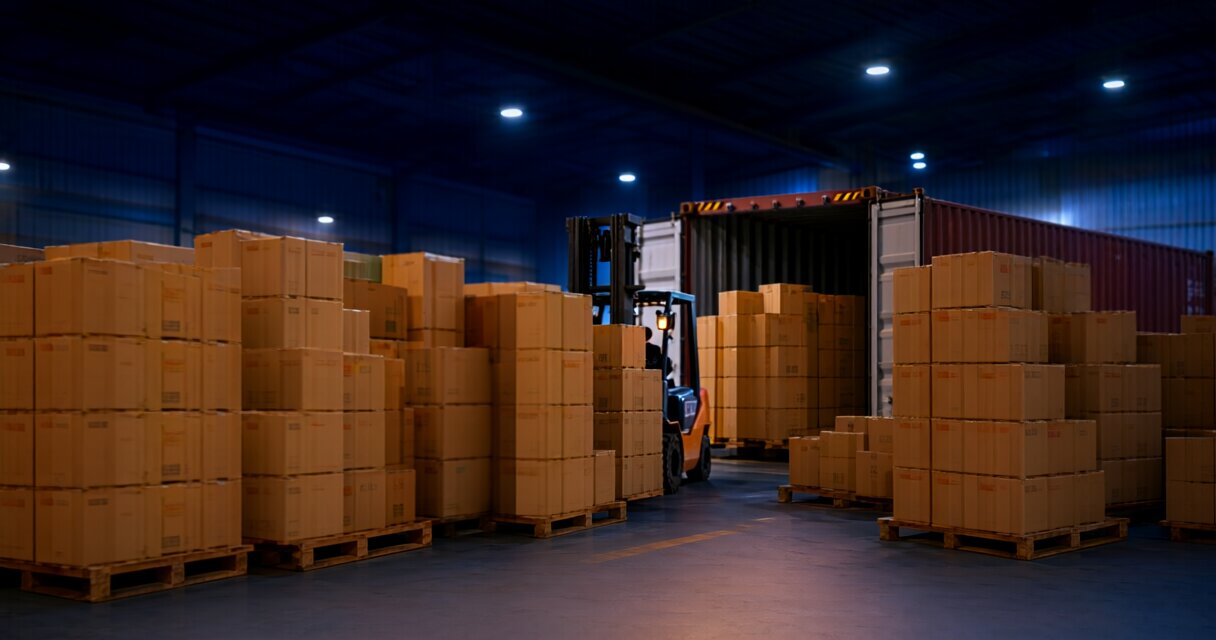
Four suppliers, four deposits, four production schedules, four freight quotes — and a container that leaves without one of them on board. That is what consolidation actually looks like the first time you try it.
The freight saving is real. So is the failure mode, and the failure mode is almost never the forwarder's fault.
I have watched buyers save a meaningful share of their freight cost by merging three suppliers into one 40HQ, then lose more than that in storage fees and a missed launch because a printed-carton supplier ran nine days late. The freight math was right. The schedule math was never done.
Why consolidation becomes unavoidable
Most importers start with one product and one factory. Freight is simple: you book a shipment, you pay for it, it arrives.
Then the catalogue grows. A toy seller adds plush, then wooden puzzles, then electronic sound modules — three different factories, three different provinces, three different lead times. Now you have three LCL shipments, three sets of destination charges, three customs entries, and three chances to be examined.
That is the point where consolidation stops being an optimization and becomes basic hygiene. The question is not whether to consolidate. It is which model, and who owns the coordination.
The four consolidation models
Every consolidation arrangement I have seen in twenty-one years fits into one of these four. They differ in who physically handles the cargo, where the merge happens, and who absorbs the risk when something goes wrong.
| Model | How it works | Best for | Main failure mode |
|---|---|---|---|
| 1. Forwarder CFS (LCL) | Each factory delivers to the forwarder's container freight station. The forwarder co-loads your cargo with other shippers' cargo into a shared container. | Small volumes, 2–5 suppliers, under roughly 12–14 CBM total, no hard deadline. | You inherit co-loaders' delays and other shippers' customs problems. Destination CFS charges stack up per shipment. |
| 2. Supplier-side loading | One factory is nominated as the loading point. Other factories truck their cartons there and the nominated factory stuffs and seals the container. | One supplier already ships FCL, goods are non-fragile, factories within a few hours' trucking distance. | The nominated factory has no contractual duty to inspect or protect incoming cartons. Damage disputes become unwinnable. |
| 3. Origin warehouse merge | A forwarder or consolidation warehouse (commonly Shenzhen, Ningbo, or Shanghai) receives all suppliers' goods, checks counts, re-palletizes, and loads a full container under your booking. | 4+ suppliers, mixed carton sizes, FBA or 3PL destination, you want one B/L and one set of documents. | Warehouse receiving fees, storage after free days, and weak accountability if counts are wrong on arrival. |
| 4. Destination merge (3PL) | Suppliers ship separately — LCL or air — to your US/UK/EU warehouse or 3PL, which merges into one inbound FBA shipment or one pallet build. | Urgent replenishment, small parcels, mixed channels, fast-moving SKUs. | You pay origin and destination charges twice. Only worth it when speed or cash flow beats freight savings. |
Model 3 is what most growing importers should be running. Model 1 is what they usually start with.
The rule that saves the most money: consolidate at origin whenever total volume crosses about 13–15 CBM, and consolidate in the destination country only when the goods are needed on shelf within weeks. Origin consolidation saves freight. Destination consolidation saves time. You rarely get both.
The cost math, with round numbers
Freight rates move constantly, so treat the figures below as a worked example rather than a quote. The structure of the math is what matters, and it does not change.
Say you are shipping about 18 CBM from three suppliers to the US West Coast. Under LCL you would pay per CBM plus a destination CFS charge, a documentation fee, and a customs entry — three times, because three shipments means three of everything.
| Cost line | 3 × LCL shipments | 1 × 20GP consolidated |
|---|---|---|
| Ocean / main freight | Charged per CBM × 18, with a minimum charge per shipment | Flat container rate, regardless of how full it is |
| Origin handling | Per-shipment CFS and documentation fees × 3 | One CFS receiving bill, one set of docs |
| Destination charges | Destination CFS, terminal, and delivery fees × 3 | One terminal and delivery bill |
| Customs entries | Three entries, three broker minimums | Usually one entry, one broker minimum |
| Inland trucking | Three pickups or three deliveries | One delivery, or three if you split at destination |
| Coordination load | Three booking confirmations, three cut-offs, three tracking threads | One booking, one cut-off — but you now chase three factories to one deadline |
The pattern is consistent: fixed per-shipment costs are what kill small importers.
That is why the breakpoint usually sits somewhere in the low-to-mid teens of CBM. Below it, LCL wins. Above it, the fixed fees of a container are cheaper than the multiplied fixed fees of several LCL bookings — even when the container is only two-thirds full.
If you want the full landed-cost build-up rather than just the freight line, the customs clearance and landed cost guide walks through duty, fees, and the costs people forget to include.
The scheduling problem is the real problem
Here is the part that sinks first orders. A container has a cut-off date. Your factories do not share a production calendar, a quality standard, or an incentive to care about each other.
If factory A finishes on the 3rd and factory C finishes on the 19th, the container leaves on the 20th. Factory A's goods sat in a warehouse for seventeen days, accruing storage beyond the free window, and factory A's payment terms probably came due while its goods were still in China.
Three habits fix most of this:
- Work backwards from the sailing date, not forwards from the order date. Take the vessel departure, subtract trucking to the consolidation warehouse, subtract the warehouse's receiving window, subtract each factory's production lead time, and subtract a buffer. Whatever date falls out is the date you write into the PO — not the date the factory offered you.
- Stagger the finish dates on purpose. It is better to have supplier A finish a week early and sit for four days than to have everyone finish the same week and discover that three trucks cannot be received on one day.
- Book the container before the goods are finished. Space is booked on a schedule, not on readiness. Waiting for the last factory to confirm production completion is how you end up paying for a rolled booking and a re-booked sailing two weeks later.
The general principle is the same one behind Chinese New Year production planning: the constraint is never one factory's capacity. It is the calendar everyone shares and nobody controls.
Who is the shipper, and why it matters
On a consolidated container there is exactly one bill of lading, which means exactly one shipper of record. This is where paperwork gets sloppy.
Three arrangements are common:
- The forwarder is the shipper. Cleanest for you. The forwarder issues a house bill of lading, you are the consignee, and each factory's goods appear on a separate commercial invoice and packing list attached to the same shipment. The master bill shows the forwarder as shipper.
- One factory is the shipper for everything. Legally awkward. That factory is declaring goods it did not make, which creates a mismatch between the shipper, the manufacturer, and the country-of-origin documentation. Avoid it if you can.
- You nominate your own shipper entity. Possible in some jurisdictions and structures, but it usually requires you to have a presence or a trading entity in China. Not the place to improvise.
Whichever you use, each supplier still needs its own commercial invoice and packing list with accurate HS codes, correct declared values, and its own country-of-origin statement. A consolidated shipment is one transport document with several underlying transactions — not one transaction pretending to be several.
Do not average HS codes across suppliers. It is tempting to let the forwarder apply one code to the whole container for simplicity. Classification is per product, and a wrong code on one SKU can affect duty, admissibility, or partner-government requirements for the entire entry. Confirm classification with your customs broker and keep each supplier's invoice itemised. Rules differ by destination and change — always verify against the official customs authority for the country of import.
Inspection has to happen before the merge
Once cartons from four factories are shrink-wrapped onto one pallet, inspection stops being meaningful. You cannot tell which carton came from which line, and the inspector cannot isolate a defective lot.
So the sequence is fixed: inspect at each factory, then release to the consolidation point. Not the other way around.
In practice that means:
- Book pre-shipment inspection for each factory against its own finish date, using the same AQL sampling plan across all of them so results are comparable.
- Do not let a factory deliver to the consolidation warehouse before its inspection report is closed. A verbal "we checked it" from a merchandiser is not a report.
- Photograph the loaded pallets and note carton counts per supplier on the warehouse receipt. This is the only evidence you will have when a carton count is short three weeks later.
- Keep one inspector or agency across all suppliers where possible. Different agencies apply different standards, and you will spend the savings arguing about whose report is right.
The quality control and inspection guide covers the sampling mechanics; the consolidation-specific point is simply that inspection is a per-factory gate, not a per-container one.
Carton marks: the least glamorous high-leverage fix
Receiving a consolidated container without proper carton marks is a genuinely miserable experience. Your 3PL opens the doors, sees 640 identical brown cartons, and starts opening them to find out what is inside.
A carton mark that works has, at minimum:
| Element | Example | Why it matters |
|---|---|---|
| Supplier code | SUP-B | Lets receiving sort the container into supplier piles without opening cartons |
| PO number | PO-2026-0417 | Links the physical carton back to the invoice and payment record |
| SKU | WD-PUZ-104 | The only field your warehouse system actually needs |
| Carton sequence | 14 of 60 | Instantly reveals a short shipment or a lost carton |
| Dimensions and gross weight | 60×40×35 cm / 18.4 kg | Needed for pallet build planning and for claims if crushed |
| Country of origin | Made in China | Required marking in most destination markets; often missed on inner cartons |
Print the mark on two adjacent sides, not one. Put it in the PO as a spec with a photo of an approved sample carton attached. Factories comply with pictures far more reliably than with paragraphs.
If the goods are going to Amazon, the carton mark also has to coexist with FBA box labels and any "Sold as Set" or "Team Lift" requirements. Those live in the FBA prep guide, and the two specs should be issued together, not in sequence.
Liability when goods damage goods
This is the gap nobody plans for. Factory A's cartons are at the bottom of the container. Factory C's heavier cartons are stacked on top. Something crushes. Factory A says its goods left in perfect condition. Factory C says it was packed to its own standard. The forwarder says it received sealed cartons and loaded as presented.
You will not win that argument without evidence created before loading:
- Photograph and weigh each supplier's pallets at the consolidation warehouse, before loading.
- Put the stacking rule in writing in the loading instruction: which SKUs go on the floor, which are top-load only, maximum stack height.
- Ask for a loading sequence photo set — empty container, half loaded, sealed with the seal number visible.
- Declare carton strength where it matters. If a factory's cartons are single-wall and the product is heavy, that is a spec problem to fix at the factory, not at the container.
Insurance is a separate conversation and worth reading alongside this one — see the product liability and recall risk guide for the coverage side, which is different from cargo damage cover.
When consolidation is the wrong answer
Consolidation has real costs, and there are situations where paying more freight is the better decision.
| Situation | Why consolidation hurts | What to do instead |
|---|---|---|
| One SKU is a launch-critical hero product | It waits for slower suppliers and misses the launch window | Ship it separately by air or LCL express; consolidate the tail SKUs |
| Goods contain lithium batteries or other regulated items | Dangerous goods rules may prevent co-loading or require separate handling | Confirm with the forwarder before booking; often a dedicated shipment |
| Very different duty rates or trade measures per SKU | One entry, one exam, one problem can hold the entire container | Consider splitting by regulatory profile, not by geography |
| High-value, fragile, or easily pilfered goods | More handling points, more hands, weaker chain of custody | Full container direct from the factory, sealed at origin |
| Suppliers are in distant provinces | Inland trucking to the consolidation point can exceed the freight saving | Compare door-to-CFS trucking per supplier before committing |
The pattern behind all five: consolidate goods that share a risk profile, and keep separate the ones that do not. Freight savings are not worth contagion risk on a single customs entry.
A working checklist for your first consolidated container
The Bottom Line
Consolidation is a coordination product, not a freight product. The forwarder sells you a container; the saving only materialises if your suppliers hit one deadline, your inspections happen before the merge, and your cartons can be sorted on arrival without opening them.
Get those three things right and a consolidated container is the cheapest logistics you will ever run. Skip them and you have simply moved your risk from the freight invoice to the warehouse floor, where it is harder to see and more expensive to fix.
Planning your first consolidated container?
Grab the free China sourcing mini-guide — the same supplier vetting, PO terms, and shipping checklists we use before committing a deposit to a new factory.
Get the Free Guide